AI
Enterprise AI Integration: A Practical Playbook for Product Leaders
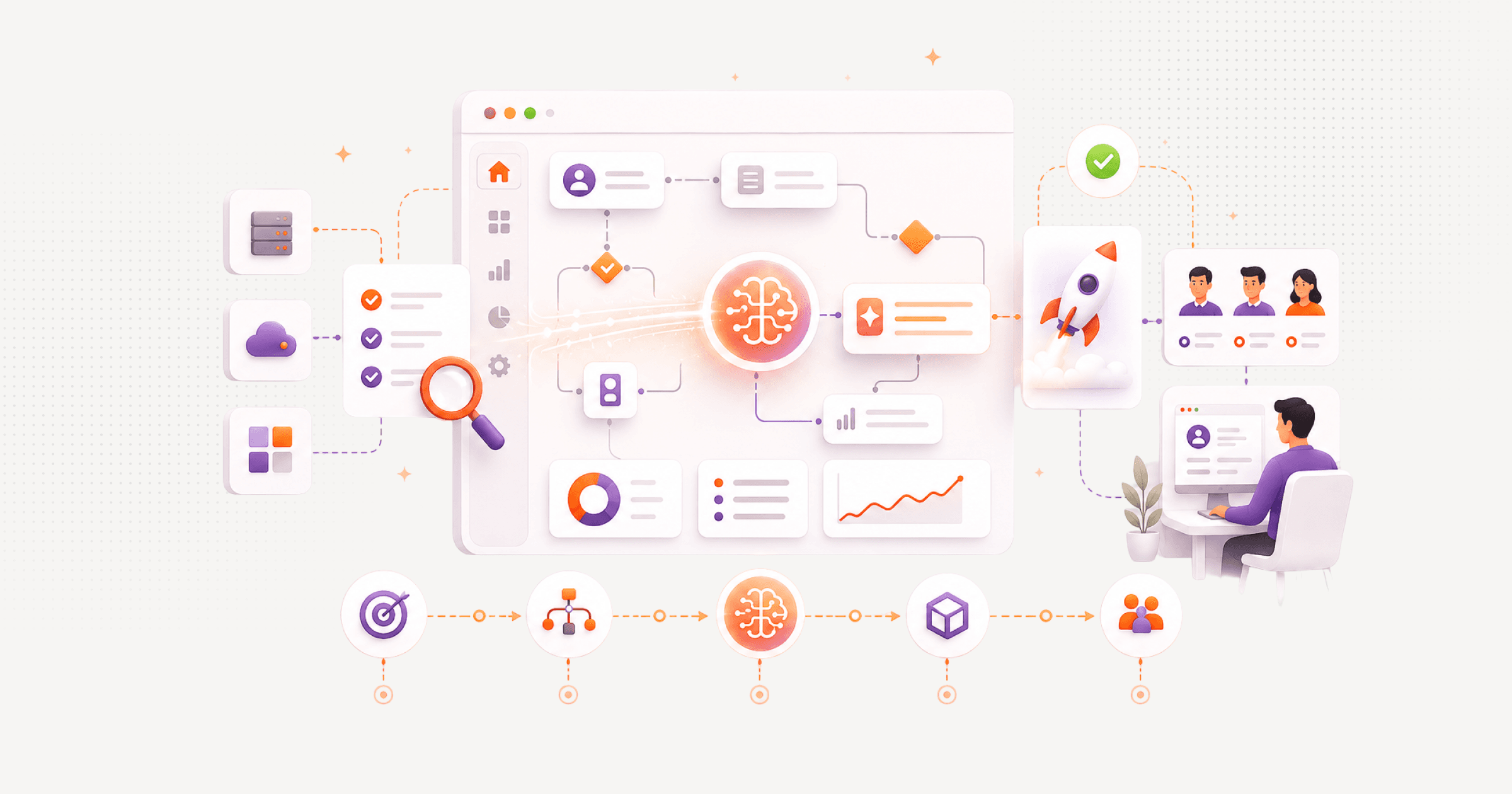
Enterprise software has entered an unusual phase.
For years, organizations invested heavily in digital transformation. They modernized applications, migrated infrastructure to the cloud, standardized data platforms, and automated repetitive business processes. Those investments created faster systems, but they rarely changed how people made decisions.
Artificial intelligence changes that equation.
Instead of simply helping software execute predefined rules, AI enables software to interpret information, generate content, summarize complex data, recommend actions, automate reasoning, and assist people throughout their daily work.
That potential explains why nearly every enterprise has launched some form of AI initiative. Internal copilots, customer support assistants, document intelligence platforms, engineering assistants, sales automation, healthcare assistants, legal research tools, and workflow agents are becoming common across industries.
Yet despite the excitement, many organizations struggle to move beyond isolated pilots. A prototype demonstrates promise during a leadership presentation, but adoption slows once employees return to their daily routines. Teams experiment with public AI tools, but concerns around security and governance delay production deployment. Departments independently purchase AI solutions that duplicate capabilities, creating fragmented experiences and inconsistent data practices. After months of experimentation, executives begin asking a difficult question: where is the business value?
The answer usually isn't that the models failed. More often, the integration strategy failed.
Successful AI products are rarely defined by the sophistication of the underlying model. They succeed because AI becomes a natural part of existing workflows, reducing friction, improving decision quality, and helping people complete meaningful work faster. The organizations seeing the strongest results today are not necessarily using the largest language models or the most advanced infrastructure. They are integrating AI into places where better decisions, faster execution, and improved customer experiences produce measurable business outcomes.
This guide presents a practical framework for enterprise AI integration. Rather than focusing on model benchmarks or technical trends, it examines how organizations can identify meaningful opportunities, prepare their systems, choose the right architectural approach, implement governance, and build AI products that employees and customers actually use.
Why most AI integration efforts fail
Technology is rarely the primary reason enterprise AI initiatives fail.
The numbers make this clear. According to MIT's Project NANDA, approximately 95% of generative AI pilots deliver no measurable return on the profit-and-loss statement. RAND Corporation's analysis of over 2,400 enterprise AI initiatives found that more than 80% of AI projects fail, roughly twice the failure rate of conventional IT projects. McKinsey's November 2025 survey found that 88% of organizations now use AI in at least one function, yet only 39% see any EBIT impact, and over 80% report no meaningful enterprise-wide results despite adoption.
The gap is rarely technical. RAND's analysis consistently identifies misaligned purpose, weak data foundations, and fading executive sponsorship as the primary causes, not the models themselves.
Many AI projects begin with enthusiasm around new capabilities instead of a clear understanding of business needs. Teams identify an impressive model, brainstorm potential applications, and build demonstrations before validating whether the proposed solution addresses an important operational challenge. These pilots often generate excitement during internal presentations but struggle to achieve sustained adoption once they reach production.
Another common issue is attempting to automate entire processes before understanding how people actually work. Business workflows are rarely linear. Employees rely on judgment, institutional knowledge, informal communication, and exceptions that may never appear in documented process maps. When AI systems ignore this complexity, users quickly abandon them in favor of familiar manual methods.
Data readiness presents another significant obstacle. Enterprise knowledge is typically distributed across multiple systems including CRMs, ERPs, internal documentation, collaboration platforms, support tickets, spreadsheets, shared drives, and legacy databases. These sources often contain inconsistent terminology, duplicated information, outdated content, and conflicting records. Even highly capable AI models cannot reliably produce accurate recommendations when their underlying knowledge base is fragmented.
Governance challenges emerge as organizations scale beyond early experimentation. Questions about privacy, regulatory compliance, model transparency, auditability, intellectual property, and human oversight become increasingly important, particularly in regulated industries such as healthcare, financial services, insurance, and manufacturing.
Many initiatives also underestimate the importance of change management. Employees need confidence that AI will support rather than replace their expertise. Without appropriate training, transparency, and opportunities for feedback, adoption frequently stalls regardless of technical quality.
Perhaps the most overlooked issue is measuring the wrong outcomes. Technical teams often focus on metrics such as response quality, latency, token costs, or benchmark performance. Business leaders, however, care about whether employees are completing work faster, whether customers are resolving issues more quickly, whether operational efficiency has improved, and whether teams are making better decisions. If these outcomes remain unchanged, even technically impressive AI implementations will struggle to justify continued investment.
Successful enterprise AI programs recognize that implementation is only one component of a broader transformation effort. They balance technology, workflow design, governance, data quality, organizational change, and measurable business value throughout the entire integration process.
An enterprise AI readiness framework
Before selecting models, building copilots, or integrating AI into existing products, organizations should evaluate whether they are prepared for production-scale adoption. AI readiness is not determined by technical infrastructure alone. It reflects an organization's ability to combine business strategy, operational maturity, data quality, governance, and execution capabilities into a sustainable program.
1. Business readiness
AI should support clearly defined business objectives rather than exist as an isolated innovation initiative. Key questions include: which operational problems have the greatest business impact, which decisions consume significant employee time, which workflows involve repetitive knowledge work, where do customers experience unnecessary friction, and which business metrics should improve after implementation. Organizations that cannot answer these questions often struggle to prioritize AI investments effectively.
2. Data readiness
High-quality outputs require reliable enterprise knowledge. Evaluate data accuracy, data ownership, documentation quality, structured versus unstructured information, duplicate records, knowledge freshness, access permissions, and integration capabilities. Improving data quality frequently delivers greater long-term value than changing models.
3. Workflow readiness
AI should complement existing workflows instead of forcing employees to adopt entirely new processes. Map current user journeys, decision points, manual bottlenecks, context switching, approval processes, exception handling, and human review requirements. The most successful AI implementations reduce friction rather than introduce additional complexity.
4. Technical readiness
Technical readiness extends beyond selecting a foundation model. Consider existing APIs, identity management, security architecture, cloud infrastructure, observability, logging, model monitoring, integration capabilities, performance requirements, and scalability. Modern AI applications often combine multiple services rather than relying on a single model.
5. Governance readiness
Enterprise AI requires clear accountability. Organizations should establish policies covering responsible AI, human oversight, privacy, regulatory compliance, bias monitoring, audit trails, data retention, security reviews, model updates, and incident response. Governance becomes increasingly important as AI decisions affect customers and business operations.
6. Organizational readiness
Technology adoption ultimately depends on people. Evaluate leadership sponsorship, cross-functional collaboration, AI literacy, employee training, change management, success measurement, feedback mechanisms, and continuous improvement processes. Organizations that invest in organizational readiness typically achieve higher adoption rates than those focused exclusively on technical implementation.
AI readiness checklist
| Question | Why it matters |
|---|---|
| Do we understand the business problem we are solving? | Without a clear problem, AI becomes a solution looking for a purpose |
| Can we identify measurable success metrics? | Adoption cannot be tracked without defined outcomes |
| Is our enterprise knowledge accessible and trustworthy? | Fragmented data produces unreliable AI outputs |
| Have we mapped the workflow AI will improve? | Workflow clarity prevents building AI for the wrong moment |
| Do we know where human oversight is required? | Defines accountability before automation decisions are made |
| Are governance policies already defined? | Retrofitting governance after launch is significantly harder |
| Can our systems integrate with AI services securely? | Security architecture must be ready before data flows to AI |
| Do employees understand how AI will support their work? | User trust is a prerequisite for adoption |
| Do we have executive sponsorship? | Without sponsorship, programs stall at the first obstacle |
| Do we have a plan for continuous improvement after launch? | AI products degrade without ongoing investment |
Identify high-value AI opportunities
Once an organization understands its readiness, the next question is rarely "which model should we use?" A better question is: where will AI improve an important business outcome?
The highest-value AI opportunities usually sit inside repetitive knowledge work rather than repetitive manual work. Think about where employees spend time reading documents, searching for information, summarizing conversations, writing repetitive responses, comparing data across systems, making routine decisions, or switching between multiple applications. These are often better candidates for AI than tasks involving highly structured automation, which traditional software already handles effectively.
Instead of asking departments what AI they want, product leaders should ask where work slows down. Some useful discovery questions include: which decisions take the longest, where do employees repeatedly search for information, which approvals create bottlenecks, which customer requests require reading multiple systems, which tasks involve producing similar outputs every day, where do experienced employees become knowledge bottlenecks, and which activities create the highest operational cost.
A practical opportunity matrix
| Quadrant | Priority | Examples |
|---|---|---|
| High impact, low complexity | Prioritize first | Internal knowledge assistants, meeting summaries, support response drafting, enterprise search, document summarization, sales proposal generation |
| High impact, high complexity | Strategic initiatives | AI copilots, claims processing, healthcare documentation, engineering assistants, AI-driven customer service, industrial maintenance recommendations |
| Low impact, low complexity | Support experimentation | Email rewriting, marketing copy generation, internal FAQ bots, presentation generation |
| Low impact, high complexity | Avoid early | Expensive infrastructure with unclear business outcomes |
AI should improve existing workflows
One of the biggest misconceptions about AI is that it should introduce completely new experiences. In reality, successful enterprise AI often feels almost invisible. Employees continue using familiar products, but certain activities become dramatically easier.
Consider customer support. Without AI, an agent must search documentation, read previous tickets, review CRM records, check product documentation, draft a response, verify policy, and then send. With AI integrated properly, context is gathered automatically, relevant documentation appears instantly, draft responses include citations, policy exceptions are highlighted, and human agents review and approve. The workflow remains recognizable. The effort changes.
This distinction matters because people adopt improvements to familiar workflows far more readily than entirely new systems. Good AI products reduce cognitive load. They don't create another application employees have to remember.
Choosing between build, buy, and hybrid
| Approach | Best when | Trade-offs |
|---|---|---|
| Buy | Capability is already mature (Microsoft Copilot, GitHub Copilot, Salesforce Einstein, Zendesk AI) | Faster deployment, lower engineering effort, but limited customization and vendor dependency |
| Build | AI creates competitive advantage (proprietary recommendation systems, domain-specific copilots, vertical AI platforms) | Complete workflow control and deeper integration, but higher engineering investment and governance responsibility |
| Hybrid | Most enterprise situations | Generic capabilities from commercial platforms, differentiating capabilities built internally |
Most enterprises ultimately choose a hybrid strategy. Generic capabilities come from commercial platforms. Differentiating capabilities are built internally. This balances speed with long-term strategic control.
Selecting the right AI architecture
One of the most common mistakes is assuming every AI problem requires the same solution. Modern enterprise AI typically combines several architectural patterns. Understanding when each approach fits is more important than understanding model benchmarks.
Retrieval-Augmented Generation (RAG). Best for internal knowledge search, documentation, enterprise search, customer support, and policy lookup. RAG retrieves relevant enterprise information before generating a response, grounding outputs in current organizational knowledge rather than model training alone. This improves accuracy while reducing hallucinations. For most enterprises, RAG is the starting point.
AI copilots. Best for employee productivity, CRM assistance, sales, engineering, healthcare, and finance. Copilots help users perform existing tasks faster. They suggest actions. They don't replace users. This human-in-the-loop model makes adoption significantly easier.
AI agents. Best for multi-step workflows, process automation, task orchestration, and cross-system execution. Agents move beyond answering questions, they perform work, creating tickets, updating CRM records, scheduling meetings, ordering supplies, and coordinating approvals. Agent-based systems require stronger governance because they take actions rather than making recommendations.
Fine-tuning. Fine-tuning becomes valuable when consistent output format matters, domain language is highly specialized, style consistency is critical, or classification accuracy must improve. Most organizations should explore RAG before considering fine-tuning.
Traditional machine learning. Generative AI is not the answer to every problem. Forecasting demand, detecting fraud, predicting equipment failures, and estimating customer churn often remain better suited to traditional machine learning. The strongest enterprise AI platforms combine predictive AI with generative AI.
Architecture should follow business workflows
Architecture discussions often begin with technology: cloud providers, vector databases, LLM vendors, inference costs, latency. Those decisions matter, but they should come after understanding how people actually work.
A workflow-first architecture asks different questions: where does the user begin, what information is already available, what decision needs support, where should AI assist, where should humans review, and what systems need updating. Thinking this way produces AI that feels like part of the product instead of an additional layer placed on top of it.
Enterprise architecture checklist
| Question | What to confirm |
|---|---|
| The workflow AI will improve | Defined and mapped before architecture begins |
| The systems AI must integrate with | All dependencies identified |
| The data AI requires | Sources confirmed, quality assessed |
| The level of autonomy AI should have | Boundaries set before implementation |
| Where human approval remains necessary | Documented and designed into the workflow |
| Which architecture pattern best supports the objective | Selected based on workflow, not trend |
| How future AI capabilities will fit into the broader product | Extensibility considered from the start |
AI is a workflow problem before it's a technology problem
The biggest mistake product teams make when integrating AI is designing around what the model can do instead of what the user is trying to accomplish. Users rarely care about capabilities in isolation. They care about completing work.
An operations manager wants to resolve an issue without opening six systems. A sales representative wants a proposal ready before a customer meeting. A healthcare professional wants relevant patient history without manually reviewing hundreds of pages. A support engineer wants the root cause of an issue before responding to a customer. In each case, AI is not the destination. It is one step within a larger workflow.
Instead of asking "where can we add AI?" product teams should ask: where does work slow down, where are people repeatedly searching for information, where do decisions require gathering context from multiple systems, and where do users perform repetitive cognitive tasks?
Design around decisions, not conversations
Many enterprise AI products default to chat interfaces because conversational models make chat easy to build. That doesn't mean chat is the right experience. In many enterprise workflows, users are not looking for a conversation. They are trying to make a decision.
Consider an insurance claims platform. The adjuster doesn't need a chatbot asking "How can I help you today?" They need policy details, similar historical claims, fraud indicators, required documentation, and suggested next actions, ideally within the claims workflow itself.
The best AI experiences often feel less like a chat interface and more like intelligent assistance woven directly into the product. Sometimes the best interface is a recommendation, a generated draft, a confidence score, a highlighted anomaly, an automatic summary, or a suggested workflow. Conversation is only one interaction model. Decision support is often the more valuable one.
The human-in-the-loop principle
One of the strongest patterns emerging across successful enterprise AI products is that humans remain responsible for important decisions. AI accelerates work. People remain accountable. This is especially important in regulated industries where recommendations can influence healthcare, financial decisions, legal outcomes, or operational safety.
Human review is valuable when AI approves payments, generates legal content, recommends medical actions, executes financial transactions, updates enterprise records, sends customer communications, or makes compliance decisions. Rather than replacing expertise, AI should amplify it. The goal is not removing humans from the process. It is allowing experts to spend more time exercising judgment and less time gathering information.
Build for confidence, not just accuracy
Most discussions around enterprise AI focus on accuracy. Accuracy matters. Confidence matters more.
Imagine two AI assistants. The first provides an answer without explanation. The second produces the same answer while also showing source documents, confidence level, supporting evidence, date of information, and alternative recommendations. Most enterprise users will trust the second system, even if both models are equally accurate.
Trust is built through transparency. Users should understand where information came from, why recommendations were made, when AI is uncertain, and how they can verify outputs. Explainability increases adoption because people understand how to evaluate AI rather than simply accepting or rejecting it.
Governance should be designed, not added later
Governance often enters the conversation after the first production deployment. By then, changing architecture becomes significantly more expensive. A 2025 Gartner survey found that 74% of IT application leaders view AI agents as a new security attack vector, and only 13% strongly agreed their organization had the governance structures needed to manage them effectively. Governance should influence product decisions from the beginning.
Data governance. Organizations should clearly define which information AI can access, which should remain restricted, how data is classified, how sensitive information is protected, data retention policies, and knowledge ownership.
Model governance. Every production AI system should answer: which model generated this response, which version is running, when was it updated, what evaluation process was completed, and what limitations are known.
Operational governance. Production systems require ongoing oversight including performance monitoring, prompt versioning, model evaluation, response quality, user feedback, incident management, and continuous improvement.
Security. AI systems introduce new security considerations because they often interact with enterprise knowledge that previously remained distributed. Security reviews should address identity management, role-based access control, prompt injection attacks, sensitive information exposure, API security, encryption, audit logging, third-party model usage, data residency, and vendor compliance.
Responsible AI. Responsible systems help users understand what AI can do, what it cannot do, when human review is recommended, what data was used, and how recommendations were generated. Users should never be surprised by AI behavior. Predictability creates trust. Good enterprise AI products acknowledge limitations instead of pretending they don't exist.
Rolling out AI across the organization
| Stage | Focus | Key activities |
|---|---|---|
| Stage 1: Pilot | Validate with a focused user group | Collect qualitative feedback, measure adoption not feature usage |
| Stage 2: Team expansion | Extend to adjacent teams | Improve prompts, improve knowledge quality, remove friction |
| Stage 3: Organization-wide | Integrate into existing products | Provide training, communicate expectations, share measurable improvements |
| Stage 4: Continuous optimization | Improve through usage | Monitor response quality, business outcomes, user satisfaction, knowledge freshness |
Change management is the real adoption strategy. Employees naturally ask whether AI will replace their role, whether they can trust recommendations, and how their work will change. Successful organizations treat AI rollout as organizational change rather than software deployment. They train employees, explain where AI helps, define human responsibilities, share early success stories, encourage feedback, and improve continuously.
Enterprise AI design checklist
| Question | Why it matters |
|---|---|
| Does AI improve an existing workflow? | AI layered over broken processes creates more friction, not less |
| Does it reduce cognitive effort? | If it adds steps, it will be abandoned |
| Can users verify recommendations? | Verifiability is a prerequisite for trust |
| Are sources visible? | Transparency is how users evaluate accuracy |
| Are confidence levels communicated? | Users need to know when to rely on AI and when to check |
| Is human review available when needed? | Especially critical in regulated or high-stakes contexts |
| Are governance policies already implemented? | Governance retrofitted post-launch is always more expensive |
| Is security integrated into the architecture? | Security cannot be bolted on after deployment |
| Do users understand the system's limitations? | Surprising users with failure destroys trust |
| Is adoption being measured alongside technical performance? | Technical success without adoption is not success |
A practical 12-month AI integration roadmap
| Phase | Timeline | Activities | Deliverables |
|---|---|---|---|
| Phase 0: Strategy | Weeks 1–4 | Interview stakeholders, map high-friction workflows, define executive sponsorship, establish governance principles | AI vision document, opportunity matrix, success metrics, governance charter |
| Phase 1: Readiness | Months 2–3 | Clean enterprise knowledge, define security policies, connect systems, create evaluation datasets | Knowledge repository, integration architecture, data quality assessment, platform selection |
| Phase 2: Pilot | Months 3–5 | Solve one meaningful workflow problem with a specific user group | Adoption metrics, qualitative feedback, time-saved measurement |
| Phase 3: Operational rollout | Months 5–8 | Monitor performance, improve prompts, expand knowledge, strengthen governance | Production monitoring, analytics, improved response quality |
| Phase 4: Cross-department expansion | Months 8–10 | Apply successful patterns to adjacent teams and workflows | Scaled platform, shared knowledge infrastructure |
| Phase 5: Enterprise AI platform | Months 10–12 | Build reusable capabilities, shared prompt libraries, central governance | Organization-wide AI standards, model management, evaluation systems |
KPIs that actually matter
| Category | Metrics |
|---|---|
| Adoption | Weekly active users, daily active users, feature adoption, repeat usage, workflow completion rate, user satisfaction |
| Productivity | Average task completion time, reduction in manual work, time saved per employee, documents processed, customer requests resolved |
| Business | Revenue growth, customer retention, operational cost reduction, employee productivity, customer satisfaction, support resolution time |
| Technical | Latency, availability, response quality, retrieval accuracy, hallucination rate, token consumption, infrastructure cost |
Common enterprise AI mistakes
Starting with technology. A stronger question than "we need AI" is "what business problem deserves a better solution?"
Ignoring workflow design. AI should improve existing work. Products that force new behaviors often struggle with adoption.
Treating data preparation as an afterthought. Organizations frequently underestimate the effort required to organize enterprise knowledge. Without trustworthy information, even the best models generate inconsistent results.
Automating too much. In practice, most enterprise workflows benefit from appropriate human oversight. Removing people too early often increases operational risk.
Measuring only technical success. If employees continue working exactly as before, the implementation has not created meaningful value.
Assuming AI is finished after launch. Enterprise AI requires continuous improvement. Knowledge changes. Business processes evolve. Models improve. User expectations increase.
Final thoughts
For the past two years, the conversation around enterprise AI has been dominated by models, benchmarks, and the pace of technological change. New capabilities appear almost every month, making it easy to believe that success depends on choosing the right model or adopting the latest breakthrough.
In practice, that is rarely what determines the outcome. The organizations seeing meaningful results from AI are not necessarily those with the biggest budgets or the newest technology. They are the ones that understand their business well enough to know where AI belongs. They identify workflows where people spend too much time gathering information, switching between systems, or repeating decisions that software can help simplify. They treat AI as part of the product experience, not as a feature added to satisfy market expectations.
This shift in perspective is important because enterprise software has never been constrained by a lack of functionality. Most organizations already have powerful systems in place. The challenge is that those systems often require people to bridge the gaps between fragmented data, disconnected processes, and complex decision-making. AI has the potential to close those gaps, but only when it is introduced with a clear understanding of how work actually happens.
That is why workflow design, trustworthy data, governance, and user adoption deserve as much attention as model selection. A technically impressive AI implementation that nobody trusts or uses creates little business value. A simpler solution that saves employees time every day often delivers far greater long-term impact.
Ultimately, enterprise AI is not about adding intelligence to software. It is about helping people make better decisions with less effort. Organizations that approach AI with that mindset will move beyond experimentation and begin building products that are not only more intelligent, but also more useful, more trusted, and more valuable over time.
Frequently asked questions
Enspirit is an AI-native product design and engineering studio. Start a conversation about what you're building.