Perspective
AI Integration vs. AI Transformation: What's the Difference?
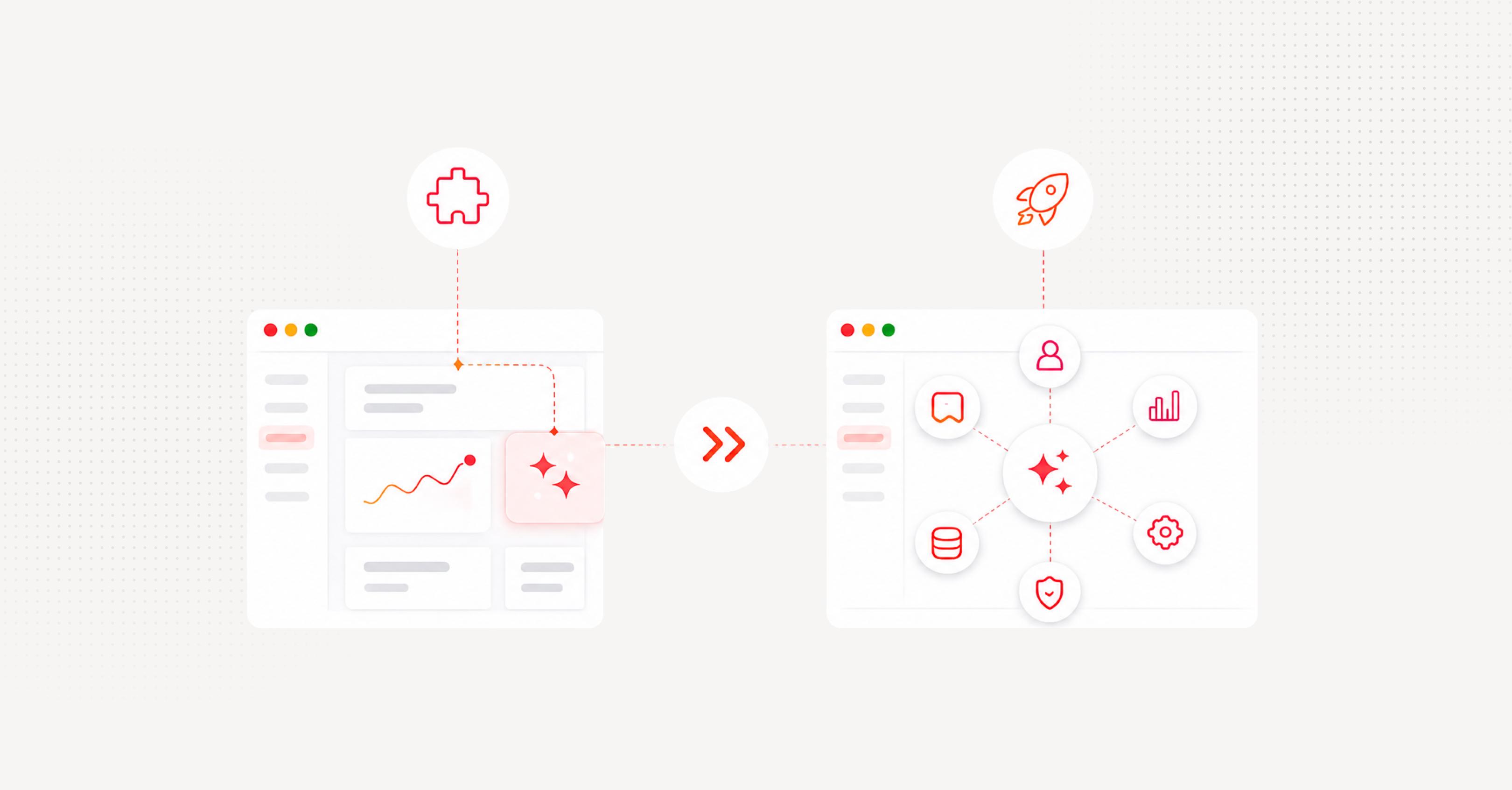
| Question | Answer |
|---|---|
| What is AI integration? | Adding AI capabilities to existing products, systems, and workflows. |
| What is AI transformation? | Redesigning products, operations, and workflows around AI capabilities. |
| Which delivers value faster? | AI integration. |
| Which creates long-term competitive advantage? | AI transformation. |
| Where should most organizations begin? | Integration first, transformation over time. |
Artificial intelligence has rapidly moved from experimentation to strategic priority. Over the past two years, organizations across every industry have invested in generative AI platforms, automation tools, predictive systems, and AI-powered software capabilities. According to McKinsey's 2025 State of AI report, 71% of organizations now regularly use generative AI in at least one business function, up from 65% the year prior, reflecting how quickly AI has shifted from experimentation to operational priority.
Despite this momentum, many organizations find themselves facing an unexpected reality. Significant investments have been made, employees are actively using AI tools, and products now include AI-powered features, yet the business often feels fundamentally unchanged. Productivity may improve, response times may decrease, and operational efficiency may increase, but the underlying workflows, decision-making structures, and operating models frequently remain the same.
This gap between adoption and impact explains why conversations about AI are increasingly shifting away from tools and toward strategy. The question is no longer whether organizations should use AI. The more important question is whether they are integrating AI into existing systems or transforming how those systems operate altogether.
Understanding this distinction has become increasingly important because the organizations creating lasting advantage are rarely those deploying the largest number of AI tools. They are the organizations using AI as an opportunity to rethink how work gets done, how products create value, and how customers achieve outcomes.
AI integration vs AI transformation: a side-by-side comparison
Although the two terms are often used interchangeably, they represent very different levels of organizational change.
| Area | AI integration | AI transformation |
|---|---|---|
| Primary objective | Improve existing processes | Redesign how work gets done |
| Scope | Team, department, or product level | Organization-wide |
| Focus | Efficiency and automation | New operating models and value creation |
| Time horizon | Weeks to months | Months to years |
| Leadership involvement | Functional leadership | Executive leadership |
| Product impact | AI-enhanced products | AI-native products and experiences |
| Workflow changes | Limited | Significant |
| Technology approach | Add AI capabilities | Build around AI capabilities |
| Competitive advantage | Often temporary | Potentially long-term |
| Success metrics | Productivity, cost reduction, speed | Growth, innovation, differentiation |
Most organizations begin with integration because it creates measurable outcomes quickly. Transformation typically emerges later when leaders recognize that AI can reshape entire workflows and business models rather than simply improving existing processes.
Understanding AI integration
Most organizations begin with integration because it offers a practical and relatively low-risk path to adoption. Instead of redesigning business operations, teams identify areas where AI can improve existing processes and introduce targeted capabilities that create immediate value.
Examples are now familiar. Customer support teams use AI to draft responses. Sales teams use AI to summarize meetings. Product teams analyze feedback with AI-powered tools. Enterprise software platforms introduce recommendation engines, predictive insights, and content generation capabilities. These initiatives improve efficiency without fundamentally changing the workflow itself.
A support agent may receive AI-generated suggestions, but they still review the information and communicate with customers. A manager may receive AI-generated summaries, but they still make the decisions. A project team may automate reporting, but the overall operating model remains intact.
The value created through integration is real. Organizations often reduce manual effort, improve response times, increase productivity, and gain better access to information. The limitation is that competitors can often achieve similar results using the same technology. Integration improves the existing system. It rarely changes the system itself.
| AI integration characteristics | Typical outcome |
|---|---|
| AI added to existing workflows | Productivity gains |
| Department-level initiatives | Faster implementation |
| Process automation | Reduced manual effort |
| AI-assisted decision-making | Better operational efficiency |
| Limited organizational change | Lower adoption risk |
Understanding AI transformation
Transformation begins when organizations stop asking where AI can be added and start asking how work should be redesigned. This shift changes the conversation entirely. Instead of improving existing workflows, leaders examine whether those workflows should exist in their current form at all. Instead of focusing on individual tools, they evaluate operating models. Instead of viewing AI as a feature, they view it as a foundational capability that influences how products are built, how decisions are made, and how value is delivered.
Consider customer support as an example. An integrated approach may use AI to help agents respond faster. A transformed approach may redesign the support model entirely, allowing AI to resolve routine issues autonomously while human teams focus on complex cases, relationship management, and strategic problem-solving. The technology may appear similar on the surface. The business outcome is very different.
Transformation often affects multiple areas simultaneously, including product strategy, workflow design, customer experience, organizational structure, and data architecture. This is one reason transformation initiatives take longer and require greater executive involvement than integration projects.
| AI transformation characteristics | Typical outcome |
|---|---|
| Workflow redesign | New operating models |
| Organization-wide impact | Strategic advantage |
| AI embedded into products | New customer experiences |
| Decision systems evolve | Faster and more scalable operations |
| Leadership-driven initiatives | Long-term competitive differentiation |
Industry examples
| Industry | AI integration example | AI transformation example |
|---|---|---|
| Healthcare | AI-assisted clinical documentation | AI-driven patient care coordination |
| Banking | Fraud detection systems | AI-first lending and risk evaluation workflows |
| Travel | AI-powered customer support | Autonomous travel planning and trip orchestration |
| Retail | Product recommendation engines | AI-driven inventory planning and demand forecasting |
| Enterprise SaaS | AI-generated summaries and copilots | AI-native workflow orchestration platforms |
In each example, integration improves a specific function while transformation changes how value is delivered across the broader system.
Why the difference matters
The distinction between integration and transformation matters because they create different forms of value. Integration typically generates efficiency gains. Organizations save time, reduce costs, and improve operational performance. These outcomes are important and often produce immediate returns. Transformation focuses on value creation. It enables organizations to develop new products, enter new markets, redefine customer experiences, and create capabilities that competitors may struggle to replicate.
This becomes increasingly important as AI adoption accelerates. Over time, many AI-powered features will become standard expectations rather than differentiators. Organizations that rely exclusively on integration may find themselves operating more efficiently while competing in essentially the same way. The more durable advantage often comes from redesigning how value is created rather than simply improving how existing processes operate.
The organizational challenge
Technology is rarely the biggest barrier to transformation. Research from McKinsey, Deloitte, IBM, and Accenture consistently shows that leadership alignment, organizational readiness, data quality, governance, and change management are often more significant obstacles than the technology itself.
Many organizations discover that AI exposes weaknesses that already existed. Fragmented data, disconnected systems, inconsistent processes, and unclear ownership become far more visible when teams attempt to scale AI initiatives. Transformation therefore requires more than technical implementation. It requires leaders to examine how decisions are made, how information flows through the organization, and how products support real-world workflows.
This is particularly relevant for enterprise software companies. Adding AI features may improve a product. Redesigning the product around AI-driven workflows may redefine its position in the market.
A practical decision framework
For leaders evaluating AI investments, a simple question can provide useful direction: Are we improving an existing process, or are we redesigning how work gets done?
If the objective is automation, efficiency, or productivity, integration may be the appropriate path. If the objective is to create new forms of value, establish long-term differentiation, or fundamentally improve how customers accomplish work, transformation may be required.
In practice, most organizations need both. Integration creates momentum, builds organizational confidence, and generates measurable results. Transformation builds on those foundations to create broader strategic impact. The most successful organizations rarely choose one or the other; they use integration to create immediate value while developing a longer-term vision for transformation.
Final thoughts
Many AI discussions focus on technology selection, model performance, or implementation timelines. These conversations are important, but they often overlook a more strategic question: how should the business operate in a world where AI is available?
Organizations that answer this question thoughtfully tend to approach AI differently. They look beyond automation opportunities and examine products, workflows, and operating models. They focus not only on efficiency but also on value creation.
Most organizations will begin their AI journey through integration. The organizations that create lasting advantage will eventually move beyond integration and rethink how products, workflows, and decisions should operate in an AI-enabled world. The technology itself is increasingly accessible. The harder challenge, and often the greater opportunity, lies in redesigning the business around what the technology makes possible.
Frequently asked questions
Enspirit is an AI-native product design and engineering studio. Start a conversation about what you're building.