Process
Build vs. Buy vs. Partner: Choosing the Right Product Development Strategy
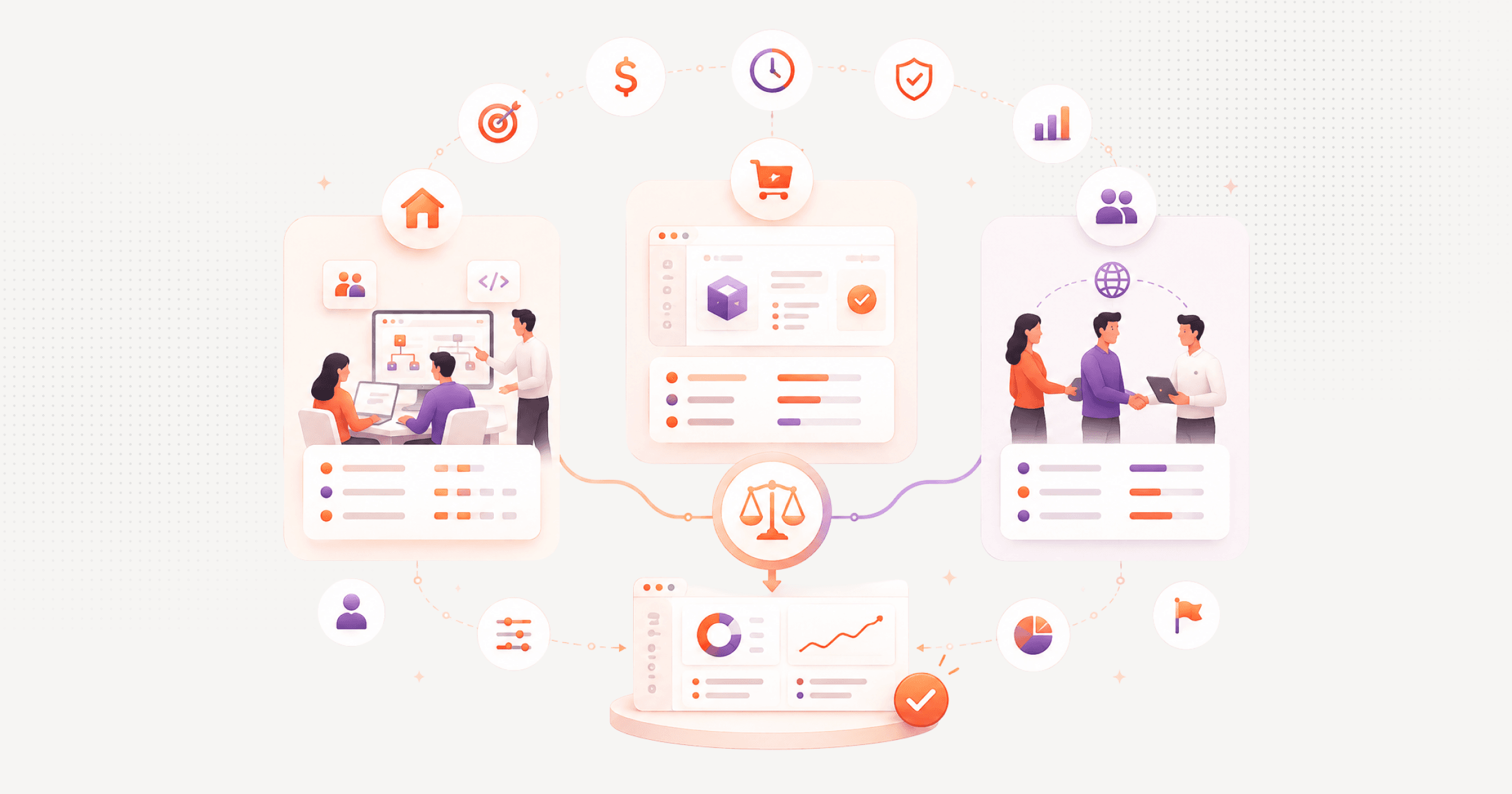
The traditional build-versus-buy debate no longer reflects how enterprise products are actually created.
Most organizations are not making one decision for an entire product anymore. They are making several decisions at the capability level: which parts of the product should remain proprietary, which capabilities are mature enough to purchase, and where an external product or engineering partner can help them move faster without giving away long-term ownership.
Gartner's current enterprise application guidance reflects this shift. Rather than treating build and buy as two opposing choices, organizations are increasingly expected to build, buy, and blend depending on the capability involved.
The same pattern is visible in how companies structure their teams. Deloitte's 2024 Global Outsourcing Survey found that 80% of executives planned to maintain or increase third-party outsourcing investment, while 70% had also selectively brought previously outsourced work back in-house during the preceding five years. 78% were using Global In-house Centers.
These numbers may appear contradictory at first. They are not. Companies are becoming more deliberate about where expertise should live. Some capabilities need to sit inside the organization. Some are better consumed through established platforms. Others matter strategically, but the internal team may not yet have the capacity or specialist experience to build them quickly enough.
That leads to a more useful way of thinking about the decision: build what creates durable differentiation, buy mature capabilities where ownership adds little strategic advantage, and partner when the capability matters but speed, expertise, or organizational capacity prevents you from building it effectively today. For many enterprise products, the practical answer will involve all three.
| Strategic choice | Best fit | Primary advantage | Primary risk |
|---|---|---|---|
| Build | Core differentiation, proprietary workflows, strategic data or IP | Maximum control and accumulated internal capability | Slow time-to-value and permanent operating burden |
| Buy | Mature, standardized, non-differentiating capability | Faster deployment and lower engineering burden | Vendor dependency, customization limits, and lock-in |
| Partner | Important capability with a speed or expertise gap | Rapid access to multidisciplinary expertise and capacity | Knowledge dependency if ownership and transfer are weak |
| Hybrid | Complex enterprise products | Optimize each capability independently | Requires stronger architecture and governance |
For AI-native products, this distinction becomes even more important. Stack Overflow's 2025 Developer Survey found that 84% of developers use or plan to use AI tools, yet only 29% trust AI outputs to be accurate. GitLab's 2024 DevSecOps research found that 35% of CxOs considered insufficient AI skills an adoption obstacle. Microsoft's 2025 Work Trend Index found that 81% of leaders expected agents to become moderately or extensively integrated into their AI strategies within 12–18 months.
The technology is moving faster than many organizations can build deep expertise internally. That does not make the case for outsourcing AI. It makes the case for intentional ownership. An enterprise might purchase foundational models and cloud infrastructure, work with specialists on its initial AI architecture and governance, and retain ownership of the proprietary orchestration, domain logic, evaluation systems, workflows, data, and customer experience that actually differentiate the product.
The question is no longer simply whether something should be built or bought. It is about deciding what deserves to be owned.
Why build vs. buy has become build vs. buy vs. partner
Software investment decisions once appeared relatively straightforward. A company could purchase an application from a vendor or assign an internal engineering team to build one. Modern enterprise products rarely fit that model.
A single product may now depend on cloud infrastructure, managed databases, authentication platforms, analytics systems, observability tools, payment services, open-source libraries, model APIs, vector databases, internal services, data pipelines, specialized UX, and proprietary workflow logic. Calling the entire system built or bought does not tell us very much.
A company can build a proprietary AI product without building its own foundation model, identity platform, database, messaging infrastructure, or cloud environment. It can purchase an enterprise platform while working with specialists to redesign critical workflows, migrate years of data, connect existing systems, and create custom capabilities around it.
It can also work with an external product team during the first generation of a strategic platform while deliberately moving knowledge and operational responsibility into the internal organization as the product matures.
That changes the question from "should we build or buy this product?" to "which capabilities should we own, which should we consume, and which should we develop with outside expertise?"
This framing matters because different capabilities create different kinds of business value. A standardized capability that can be purchased reliably may not deserve years of engineering investment. A workflow that carries proprietary domain knowledge may deserve very close internal ownership. A strategically important capability may need to be custom-built, but that does not automatically mean the company already has every specialist required to build it well. This is where the partner option belongs.
The market is already moving toward blended models
Deloitte's 2024 Global Outsourcing Survey found that 80% of surveyed executives planned to maintain or increase third-party outsourcing, while 70% had selectively insourced work during the preceding five years. Those movements are happening at the same time because the objective is changing. Organizations are no longer choosing between an internal organization and an external one. They are constructing capability portfolios.
The outsourcing conversation is also moving beyond cost. Deloitte found 50% of surveyed organizations had used outsourcing for front-office functions such as sales, marketing, or R&D, and identified skilled talent and agility alongside cost as major drivers. Deloitte also reported that 83% of surveyed executives were using AI in some form within outsourced services, while only 25% reported lower vendor-service cost or improved service quality from it. Having access to a technology is clearly not the same as developing a capability around it.
Pressure on internal teams is increasing at the same time. Microsoft's 2025 Work Trend Index found 53% of leaders said productivity needed to increase, while 80% of employees and leaders reported insufficient time or energy to complete their work. GitLab's research found 69% of surveyed CxOs said their organizations were shipping software at least twice as fast as the previous year, yet 35% identified missing AI skills as an obstacle.
Businesses are being asked to move faster while the technology they are adopting requires increasingly specialized knowledge. That tension is one of the strongest reasons to stop making product sourcing decisions at the company-wide level. The useful question is where ownership creates strategic value, and where outside capability can help the organization reach that value sooner.
Think of the product as a set of capability layers
| Product layer | Typical strategic approach |
|---|---|
| Customer experience and domain workflow | Often build |
| Business rules and proprietary intelligence | Usually build |
| Data, AI orchestration, and integrations | Build + partner |
| Application platform and shared services | Buy + partner |
| Cloud, databases, identity, and infrastructure | Usually buy |
This is not a fixed architectural rule, but it exposes a useful pattern. The closer a capability gets to proprietary workflows, customer understanding, domain knowledge, or competitive differentiation, the stronger the argument for organizational ownership. The more standardized, repeatable, mature, and operationally burdensome the capability becomes, the stronger the argument for purchasing or consuming it as a managed platform.
This is often where partnership becomes useful: the company needs a differentiated capability, intends to retain control of it, but does not currently have all the product, design, engineering, architecture, AI, or delivery experience required to create it at the necessary pace.
A practical build, buy, or partner decision framework
The most important principle is simple: do not make one build, buy, or partner decision for the entire product. Make the decision capability by capability.
| Decision factor | Build | Buy | Partner |
|---|---|---|---|
| Strategic differentiation | Strongest when capability creates competitive advantage | Best when capability is standardized | Strong when differentiation matters but capability is missing internally |
| Time to first value | Usually slower when team or architecture must be created | Usually fastest for mature capabilities | Often faster than building a complete internal team |
| Control over roadmap | Highest | Lowest to moderate | High when IP and architecture remain client-owned |
| Customization | Maximum | Limited by vendor | High |
| Internal talent requirement | High and persistent | Lower engineering requirement | Moderate internal ownership plus external expertise |
| Long-term operating burden | Highest | Partly transferred to vendor | Depends on operating and handoff model |
| Knowledge accumulation | Primarily internal | Mostly configuration and vendor knowledge | Shared, with deliberate transfer inward |
| Ability to scale capacity temporarily | Limited by hiring | Not applicable | High |
| Best use | Core IP, unique workflows, proprietary intelligence | Mature and repeatable capabilities | Strategic initiatives with capacity or expertise gaps |
1. Does the capability create durable differentiation?
This should usually be the first question, not cost. If a capability directly shapes why customers choose the product, how the business operates differently, or what the organization knows that its competitors do not, ownership has strategic value. Technical difficulty and strategic value are not the same thing.
2. Is the requirement genuinely unique?
Organizations often inherit processes that feel unique simply because they have existed for a long time. The distinction that matters is between competitive uniqueness and historical complexity. Custom-building historical complexity usually preserves the problem instead of solving it.
3. Can an existing product meet the requirement without distorting the workflow?
Buying makes sense when the market has already solved the problem well enough. A platform that supports 90% of the requirements can still be the wrong choice if the remaining 10% represents the workflow that matters most. The decision needs to evaluate the actual workflow, not the number of checkboxes matched.
4. Can we operate what we build?
Building is not a one-time development project. It creates an ongoing responsibility for security updates, monitoring, incident response, performance, technical debt, accessibility, dependency upgrades, API evolution, data migration, documentation, quality engineering, infrastructure, compliance, onboarding, and future development. The relevant question is whether the organization wants to become permanently responsible for that capability.
5. How urgent is the opportunity?
McKinsey's research on large-scale digital transformations notes that strong organizations can meet a significant portion of digital talent needs through internal upskilling, while specialized roles may still require outside expertise. Partnership is most useful here as a bridge between strategic ownership and delivery urgency. The objective is not permanent dependency, it is reaching the required capability sooner while making the internal organization stronger in the process.
6. How reversible is the decision?
A low-cost decision can become expensive when the organization needs to leave it. Before purchasing a platform, leadership should understand how data can be exported, how deeply internal workflows will depend on proprietary APIs, what contractual exit rights exist, and what migration would require. AI introduces additional questions around model portability, prompts, embeddings, customer data, evaluation systems, and whether proprietary data can be used by the vendor for training.
Where should ownership sit?
| Capability | Typical ownership position | Where external capability can help |
|---|---|---|
| Product vision | Internal | Strategy and discovery facilitation |
| Customer and domain knowledge | Internal | Research synthesis and service design |
| Product UX | Shared | Complex workflows, research, design systems |
| Core business logic | Internal | Architecture and implementation acceleration |
| Foundation AI models | Usually purchased | Model selection, evaluation, integration |
| AI orchestration and domain intelligence | Often internal | Architecture, evaluation, guardrails |
| Cloud infrastructure | Internal governance, managed infrastructure | Architecture, migration, FinOps, DevOps |
| Identity and authentication | Internal security accountability | Platform selection and enterprise integration |
| Analytics infrastructure | Shared | Data architecture and migration |
| Design systems | Usually internal ownership | Creation, accessibility, and adoption |
| Cybersecurity | Internal accountability | Specialist assessment, audits, tooling |
| QA and automation | Shared | Test strategy and automation |
| Architecture decisions | Internal/shared | Specialist review and implementation |
The important distinction is between performing the work and owning the decision. Organizations can bring in specialists to execute substantial portions of a product without transferring accountability for product direction, customer outcomes, security, data, architecture principles, or strategic IP.
Cost, time-to-value, and risk
The cost of building goes well beyond salaries
The U.S. Bureau of Labor Statistics reports a May 2024 median annual wage of $133,080 for software developers. In March 2026, BLS reported that wages and salaries accounted for 69.9% of total private-industry employer compensation, with benefits accounting for 30.1%. Using that broad compensation ratio illustratively, the direct compensation associated with the median developer wage reaches roughly $190,000 annually before recruiting, equipment, developer tooling, management, cloud infrastructure, office costs, or unfilled positions are considered. That would place an illustrative six-developer team above $1.14 million in annual direct compensation and an eight-developer team above $1.52 million, before the other costs of running the capability.
These are not software-industry-specific team cost benchmarks. Actual costs vary considerably by geography, seniority, role mix, benefits, equity, recruiting model, and labor market. The purpose of the calculation is more basic: build should never be modeled as salary alone.
| Cost category | Build | Buy | Partner | Hybrid |
|---|---|---|---|---|
| Discovery and strategy | Internal team time | Configuration/scoping | Partner + internal team | Shared |
| Recruiting | Potentially high | Low | Low | Selective |
| Salary and benefits | High and permanent | Lower | Internal ownership team | Focused internal core |
| Software licensing | Tooling | Primary recurring cost | Supporting tools | Mixed |
| Cloud and compute | Direct | Included or consumption-based | Usually client cost | Mixed |
| Migration | Internal effort | Often substantial | Explicit workstream | Shared |
| Integration | Internal effort | Can be substantial | Often a core responsibility | Shared |
| Security and compliance | Fully internal burden | Shared | Shared | Shared with clear accountability |
| QA and reliability | Internal staffing | Vendor + customer validation | Partner + internal | Shared |
| Maintenance | Ongoing internal responsibility | Partly included | Depends on engagement | Deliberately divided |
| Exit and migration | Internal re-platforming | Potentially high | Knowledge-transfer cost | Designed upfront |
| Opportunity cost | Can be high | Lower for commodity capabilities | Reduced through added capacity | Optimized capability by capability |
Time-to-value planning bands
There is no defensible universal rule on timelines. The answer changes with product size, integration depth, regulation, data quality, procurement, security requirements, legacy architecture, and the capability of the team involved.
| Strategy | Initial value planning band | Broader enterprise value planning band |
|---|---|---|
| Buy | 4–12 weeks for a contained use case | 3–9+ months for integrated enterprise rollout |
| Partner | 2–6 weeks to mobilize/discover; 6–16 weeks for a meaningful first release in favorable conditions | 3–12+ months depending on scope |
| Build with an existing capable team | 1–3 months to validate or prototype | 6–18+ months for a significant production platform |
| Build while hiring | Hiring may precede meaningful delivery | Frequently adds months before full productivity |
| Hybrid | 6–12 weeks for a narrow first capability | 12–18 months for broader modernization and capability transfer |
These are Enspirit planning ranges, not claimed industry averages. They should be replaced with project-specific estimates once the actual architecture, team, dependencies, and business constraints are understood.
Risk by model
| Risk | Build | Buy | Partner |
|---|---|---|---|
| Delivery delay | Higher when team/capability is missing | Lower for standard deployments | Moderate |
| Vendor lock-in | Lower | Higher | Moderate |
| Operational burden | Highest | Lower | Shared |
| Customization constraints | Low | High | Low |
| Talent dependency | High | Lower | Moderate |
| Roadmap control | High | Vendor-dependent | Shared |
| Knowledge loss | Staff turnover | Vendor dependency | Partner dependency |
| Exit complexity | Internal re-platforming | Potentially high | Moderate |
| Technical debt | Internally visible | Can hide in integrations and configuration | Shared |
| Security/accountability | Internal | Shared | Shared |
Governance matters more as the model becomes hybrid
Once internal teams, cloud platforms, SaaS providers, AI vendors, and product partners begin working inside the same product environment, sourcing itself becomes less difficult than coordination. The organization needs clear decision rights.
Deloitte's 2024 research found that only 20% of surveyed executives said their traditional Vendor Management Office owned the extended-workforce strategy, while 70% said the VMO function was not fully mature. A practical governance structure can operate at four levels.
| Governance layer | Primary responsibility |
|---|---|
| Executive steering group | Outcomes, investment, strategic scope, major risks |
| Product leadership group | Roadmap, priorities, user outcomes, dependencies |
| Architecture and risk council | Architecture boundaries, security, data, AI governance |
| Delivery squads | Discovery, design, engineering, QA, and release |
The organization should retain final accountability for product vision, customer outcomes, investment, business rules, data governance, security acceptance, architecture principles, strategic IP, operational readiness, and exit decisions. External specialists can still take substantial responsibility for product research, UX design, engineering, architecture implementation, AI integration, modernization, DevOps, testing, documentation, and delivery. The distinction is simple: execution can be shared without making accountability ambiguous.
Knowledge transfer has to happen while the product is being built
Documentation created during the final week of an engagement is not knowledge transfer. Architecture decisions should be recorded when they are made. Internal engineers should participate in reviews. Deployment pipelines should remain accessible to the organization. Research should remain visible to internal product owners. Design systems and source code should live in organization-controlled environments. The objective is not a ceremonial handoff, it is an organization that gradually understands more of the product as the engagement progresses.
Evaluate partners for more than capacity
| Evaluation area | What leadership should establish |
|---|---|
| Product thinking | Can the team question requirements and understand outcomes? |
| Relevant expertise | Have they worked with comparable complexity? |
| Seniority | Who will actually perform the work? |
| Security | How are source code, data, access, and supply-chain risks handled? |
| Architecture | Will the system remain understandable, modular, and replaceable? |
| Data ownership | Can organizational data be exported and moved? |
| AI data terms | How can prompts, outputs, and customer data be used? |
| IP ownership | Who owns the code, designs, models, prompts, and documentation? |
| Reliability | How are recovery, incidents, and operational performance handled? |
| Pricing | What happens as usage grows significantly? |
| Knowledge transfer | How does capability move into the organization? |
| Exit | Can the organization leave without rebuilding everything? |
Staff augmentation primarily adds capacity. A product partner should add judgment, including product strategy, design, engineering, architecture, AI, quality, and delivery, with accountability for solving the problem rather than supplying a predetermined number of people.
A practical roadmap for the first 18 months
| Phase | Approximate timing | Primary focus |
|---|---|---|
| Frame | Months 1–2 | Business outcomes, capability map, initial build-buy-partner decisions |
| Select | Months 2–4 | TCO, risk, architecture principles, vendor and partner evaluation |
| Prove | Months 4–7 | Thin-slice discovery and first production capability |
| Scale | Months 7–12 | Broader rollout, workflows, reliability, security, and observability |
| Transfer | Months 9–18 | Internal capability, documentation, architecture knowledge, reduced dependency |
| Reassess | Around Month 18 | Outcomes, economics, ownership, and next decisions |
During the first two months, avoid selecting platforms too early. The important work is understanding business capabilities, strategic differentiation, measurable outcomes, existing constraints, and the ownership model. The result should be simple enough to explain clearly: these capabilities will remain inside the organization, these will be purchased, these will be developed with outside specialists, and these decisions will remain reversible wherever possible.
The strategic recommendation
There is no maturity badge attached to any one sourcing model. Building everything internally does not automatically make an organization technologically sophisticated. Buying established platforms does not mean the company lacks technical depth. Working with an external product team does not automatically make the organization more agile.
The more useful measure of maturity is whether leadership understands what deserves ownership and why. For most enterprise products, that leads to four practical principles.
Build the differentiation. The organization should retain control over the workflows, domain intelligence, proprietary data loops, algorithms, business rules, and product experiences that create meaningful competitive advantage. That does not require every line of code to be written by an employee. It requires the organization to understand, govern, and retain control of the capabilities its business depends on.
Buy mature capabilities. Technical complexity is not automatically a reason to build. In many cases it is the strongest reason not to. Managed infrastructure, identity, databases, observability, communication systems, enterprise platforms, and many foundational AI capabilities represent years of specialized engineering that an organization can consume without recreating internally.
Partner across the capability gap. There are moments when the organization knows what needs to be owned but does not yet have every capability required to build it at the right pace. A strong partner helps close that gap without taking ownership of the product away from the organization.
Blend at the product level. A modern enterprise product may use commercial identity, managed cloud infrastructure, a third-party foundation model, internally owned data and business logic, external product specialists, internal engineering teams, and purchased observability tooling simultaneously. The strategic unit is the capability. Which ownership structure gives us this capability soon enough, at sustainable cost, with acceptable risk, enough control, and the ability to evolve it over the next several years? Sometimes that answer will be build. Sometimes it will be buy. Sometimes it will be partner. For a significant enterprise product, it is increasingly likely to be a deliberate combination of all three.
Final thoughts
There is no universally correct answer to the build vs. buy vs. partner question. The right decision changes by capability, by stage of the product, by the organization's current expertise, and by how urgently the outcome is needed.
What does not change is the underlying principle: the capabilities that create competitive advantage deserve organizational ownership, and the capabilities that do not may be better consumed, purchased, or developed with outside expertise.
The organizations that make this distinction deliberately, at the capability level, with clear governance, and with knowledge transfer built in from the start, tend to build stronger products, accumulate more internal capability over time, and make better decisions about where to invest next.
The question is not whether to build, buy, or partner. It is which combination gives each capability the best chance of creating lasting value.
Frequently asked questions
Enspirit is an AI-native product design and engineering studio. Start a conversation about what you're building.