Perspective
Embedded Product Design Team vs Hiring In-House: Which Model Scales Better in 2026?
What is an embedded product design team?
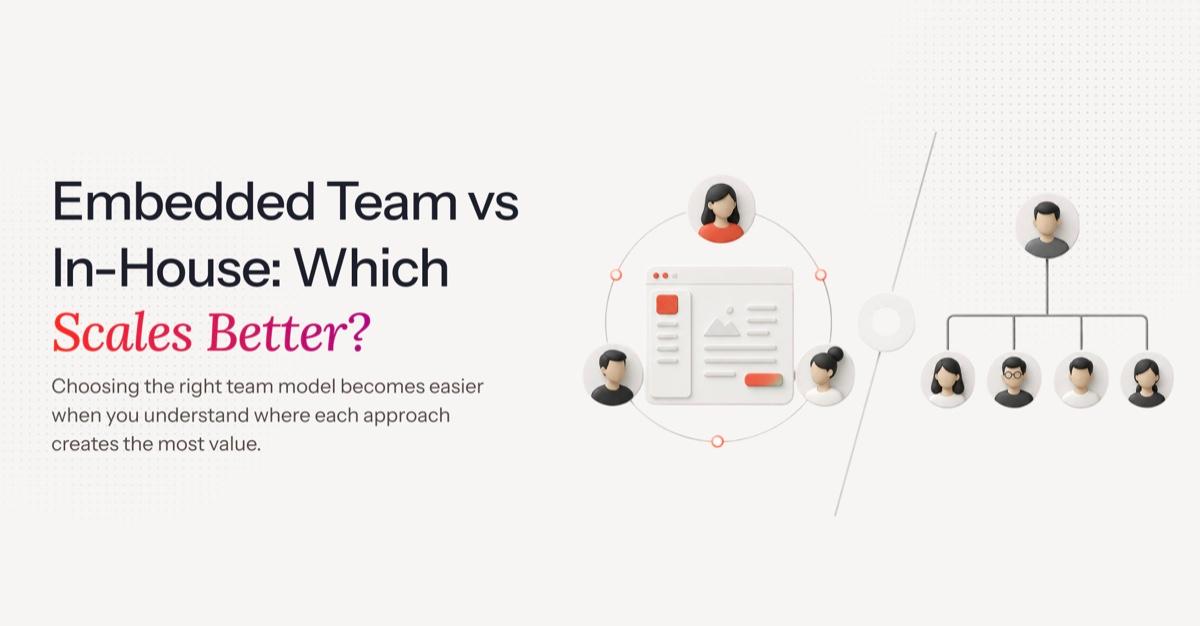
An embedded product design team is a group of designers who work inside your product organization while remaining part of an external product partner. Unlike traditional agency relationships, embedded teams participate in roadmap planning, discovery, research, design reviews, sprint planning, and delivery alongside internal stakeholders.
The question most companies ask is whether they should hire internally or use an embedded team. The better question is whether they need to build capability or acquire capability.
Hiring builds capability over time. Embedded teams provide capability immediately. Neither model is universally better. The right choice depends on the maturity of your product organization, the speed of your roadmap, and the complexity of the problems you are trying to solve.
Most companies think this is a hiring decision
Most organizations do not wake up one morning and decide they need an embedded product design team. The conversation usually begins somewhere else. A roadmap starts slipping. A redesign takes longer than expected. Engineers find themselves debating workflows that have never been fully defined, while product managers become the default UX team simply because nobody else is available.
At the same time, hiring plans are approved, but the business needs answers long before a new designer can join and become productive.
That is usually the moment the discussion changes. The challenge is no longer about filling a role. It becomes a question of capability. More specifically, how quickly the organization can access the capability needed to move the product forward.
Most teams do not have a design problem
One pattern appears repeatedly across product organizations. When leaders say they need more designers, what they often mean is that product decisions are taking too long, workflows are unclear, or ownership has become fragmented.
The bottleneck is rarely screen design. More often, it is unclear product strategy, competing stakeholder priorities, disconnected workflows, or a lack of alignment between product, design, and engineering.
Adding more design capacity to an unclear process rarely produces better outcomes. The strongest organizations focus on capability before capacity.
What does an embedded product design team actually do?
Unlike project-based agencies that work independently and deliver design files at predefined milestones, embedded teams become part of the product delivery process. They work alongside product managers, engineers, researchers, and business stakeholders throughout the lifecycle of a product.
Typical responsibilities include:
- Product strategy discussions
- Discovery and user research
- Workflow and information architecture design
- UX and UI design
- Design reviews
- Sprint planning
- Engineering collaboration
- Product delivery support
The goal is not external execution. The goal is shared ownership of product outcomes.
The product capability framework
Most organizations compare hiring and embedded teams using cost. Cost matters, but it is rarely the deciding factor. The strongest decisions are usually made by evaluating five dimensions: speed, expertise, continuity, flexibility, and organizational maturity.
Instead of asking, "Which option is cheaper?" the better question is, "Which option gives us the capability we need when we need it?"
The hidden costs most leaders do not budget for
When organizations compare hiring with embedded teams, salary is usually the first number that enters the discussion. It is also the easiest number to calculate.
The larger costs tend to appear later. Recruitment takes time, and product roadmaps rarely slow down while teams search for the right candidate. Even after someone joins, they still need to learn the product, understand customer behavior, and build relationships across the organization before they can contribute at full capacity.
There is also management overhead. Strong design teams require leadership, mentoring, governance, and alignment across product and engineering.
Many organizations discover challenges they were not planning for, including inconsistent design patterns, fragmented user experiences, research gaps, and the absence of a scalable design system. These costs rarely appear in the original hiring plan, yet they often have the greatest impact on delivery timelines.
Why this decision has become harder in 2026
A few years ago, this discussion was relatively straightforward. Today, product organizations face a different environment.
AI has fundamentally changed product roadmaps. Teams now need expertise in AI workflows, trust models, human-in-the-loop experiences, and AI-assisted decision making. Enterprise software has also become more complex. Products increasingly connect multiple systems, data sources, compliance requirements, and operational workflows.
At the same time, user expectations continue to rise. Users compare business software against every exceptional digital experience they encounter elsewhere. As a result, many organizations need capability faster than traditional hiring cycles can provide.
Three common scenarios we see
Scenario 01
Launching AI features
A SaaS company wants to introduce AI-assisted workflows before a major customer renewal cycle. Hiring a senior product designer could take several months, leaving little time for discovery, testing, and implementation. In this situation, an embedded team often provides faster access to product strategy, UX, AI workflow design, and delivery support.
Scenario 02
Modernizing a legacy platform
A company has a product that has evolved over a decade. The challenge is not a lack of screens. It is fragmented workflows, inconsistent experiences, and growing user frustration. Embedded teams are often brought in to accelerate modernization while internal teams maintain day-to-day delivery.
Scenario 03
Scaling a product team
A growing SaaS company has strong product-market fit but limited design capacity. Hiring remains important, but an embedded team can help bridge capability gaps while the internal organization scales.
Embedded team vs in-house vs staff augmentation vs agency
| Model | Best for | Primary limitation |
|---|---|---|
| In-house team | Long-term ownership and continuity | Slower hiring and scaling |
| Embedded team | Accelerating capability and delivery | Requires close collaboration |
| Staff augmentation | Temporary capacity gaps | Limited strategic impact |
| Traditional agency | Defined project work | Limited integration into product teams |
Which model fits your situation?
| Situation | Best fit |
|---|---|
| Building a long-term product organization | In-house team |
| Modernizing a legacy platform | Embedded team |
| Launching AI initiatives | Embedded team |
| Filling temporary resource gaps | Staff augmentation |
| Running a defined redesign project | Agency |
| Scaling delivery quickly | Embedded team |
| Stable roadmap and predictable growth | In-house team |
| Product transformation initiative | Embedded team |
When hiring in-house makes more sense
Hiring internally is often the strongest option when the product is mature, growth is predictable, and long-term ownership is critical. Organizations with established design leadership, stable roadmaps, and strong operational processes often benefit from building capability internally.
When embedded teams create more value
Embedded teams often create stronger outcomes when organizations are modernizing legacy products, launching AI initiatives, addressing delivery bottlenecks, scaling product teams rapidly, or introducing specialized expertise. The value comes from reducing the time between identifying a problem and solving it.
So which model should you choose?
If your organization has time to build capability and long-term ownership is the primary objective, hiring in-house is often the right choice.
If your organization needs product expertise, modernization support, AI capabilities, or delivery acceleration within the next quarter, an embedded product design team is often the faster path.
The decision is not about which model is better. The decision is about which capability gap needs to be solved.
Conclusion
The decision between hiring in-house and working with an embedded product design team is rarely about headcount. It is about capability.
Internal teams provide continuity, ownership, and deep organizational knowledge. Embedded teams provide immediate access to specialized expertise, broader product experience, and accelerated execution when business priorities cannot wait for traditional hiring cycles.
The strongest product organizations do not treat these models as competing options. They use them strategically. They build internal capability where long-term ownership matters and bring in external expertise when speed, transformation, or specialized knowledge is required.
In practice, the organizations that scale most effectively are often the ones that understand when to build capability and when to acquire it.
Frequently asked questions
Enspirit is an AI-native product design and engineering studio. Start a conversation about what you're building.