Process
Choosing Between In-House and External Product Teams
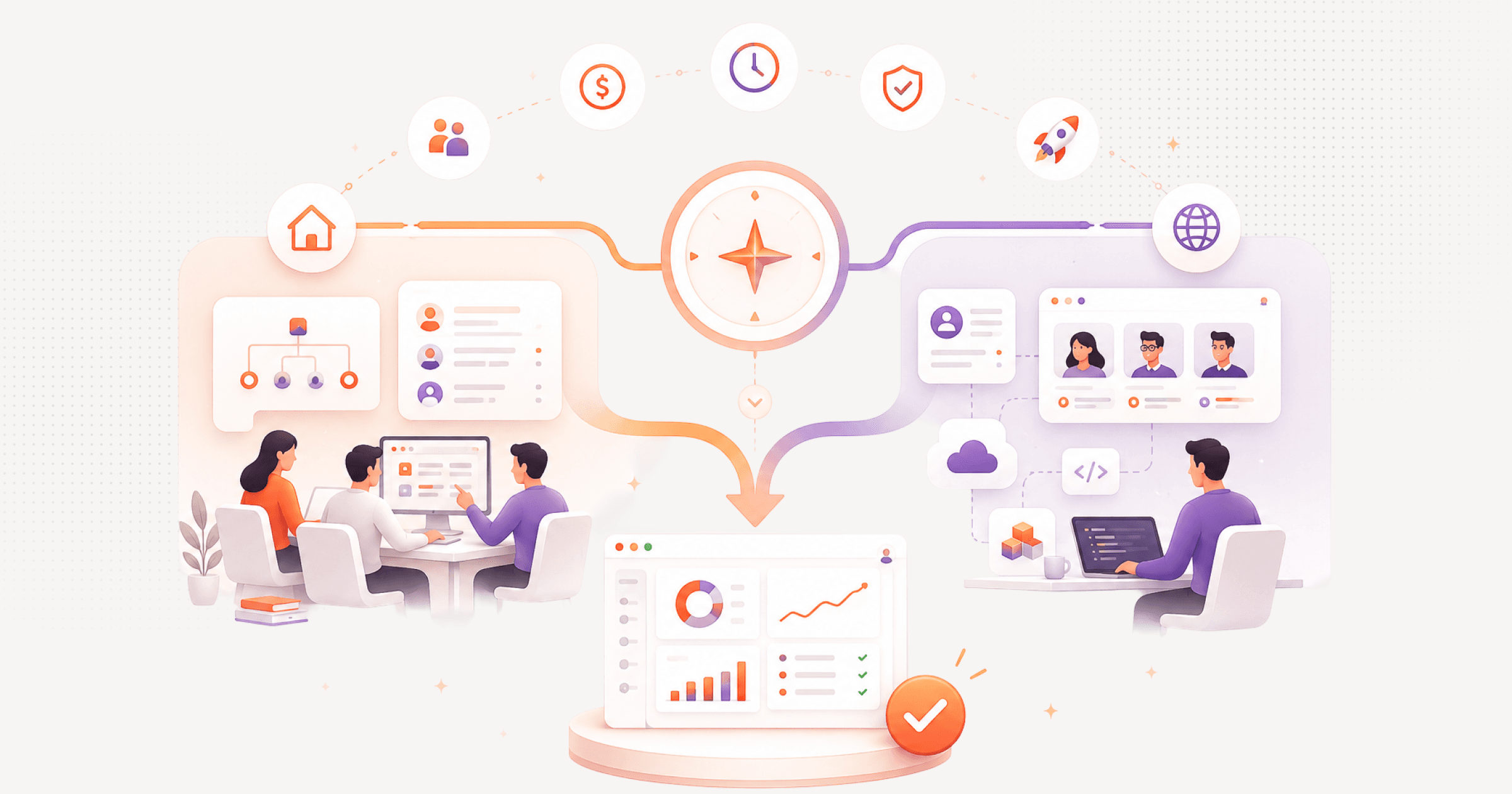
One of the most common assumptions in software development is that building an internal team is always the ideal long-term strategy.
On the surface, the reasoning seems straightforward. Internal employees understand the business, work closely with stakeholders, and remain with the product as it evolves. If product knowledge stays inside the organization, surely delivery becomes more effective over time.
Yet many organizations discover that reality is more complicated.
Hiring an experienced product team takes time. Building expertise across product management, UX, engineering, QA, DevOps, cloud infrastructure, AI, accessibility, and security can take considerably longer. By the time the team reaches full productivity, market priorities may already have shifted.
The opposite assumption can be equally problematic. Some organizations view external product teams primarily as a way to reduce costs or increase engineering capacity. While experienced product partners certainly provide additional delivery capability, the most effective partnerships extend far beyond execution. They contribute product thinking, design expertise, architectural guidance, modernization experience, and delivery practices that have been refined across multiple organizations and industries.
As products become more sophisticated, the choice between internal and external teams is becoming less about ownership and more about assembling the right capabilities at the right time. Instead of asking whether one model is inherently better, product leaders are increasingly asking a different question: which operating model gives this product the highest probability of success over the next several years?
That shift matters because modern software development is no longer constrained by engineering alone. Organizations building enterprise platforms, AI-enabled products, customer-facing applications, or large-scale modernization initiatives must coordinate product strategy, user experience, cloud architecture, security, analytics, compliance, accessibility, automation, and continuous delivery. Very few organizations need every one of those capabilities at full capacity all the time.
The challenge, therefore, is not choosing between internal teams and external partners. The challenge is determining which combination of ownership, expertise, flexibility, and delivery speed best supports the product at its current stage.
Why this decision has become more complex
Ten years ago, many software products could be delivered by relatively small teams focused primarily on engineering. Today's products look very different. A modern enterprise platform spans a broad range of disciplines that each evolve independently.
| Discipline | Examples |
|---|---|
| Product & Strategy | Product management, discovery, roadmap planning |
| Design & Research | UX research, UI design, design systems, accessibility |
| Frontend Engineering | Web, mobile, cross-platform delivery |
| Backend & Data | APIs, services, data engineering, analytics |
| Infrastructure | Cloud platforms, DevOps, continuous deployment |
| Quality & Security | QA automation, security, performance engineering |
| Emerging Capabilities | AI integration, automation, observability |
Keeping pace with every technology, framework, security standard, accessibility guideline, and AI capability has become increasingly difficult for any single organization.
The pace of change is evident in industry research. According to the 2024 Stack Overflow Developer Survey, 63% of developers reported learning a new programming language, framework, or technology during the previous year, reflecting how quickly technical skills continue to evolve.
At the same time, the 2024 GitLab Global DevSecOps Report found that 78% of organizations are already using AI in software development or expect to within the next two years. AI is changing software engineering itself, introducing new capabilities alongside new expectations for development teams.
For many organizations, the challenge is no longer finding engineers. It is maintaining expertise across an expanding range of specialized disciplines while continuing to deliver products at market speed.
The three product delivery models
The discussion is often framed as a choice between hiring internally and outsourcing development. In practice, most organizations operate somewhere between those two extremes. Three delivery models have emerged as the most common.
Fully in-house teams. The organization hires, manages, and develops every capability internally, including product management, UX research, product design, frontend and backend engineering, QA, DevOps, security, and data engineering. This approach provides maximum continuity and product ownership but requires sustained investment in recruitment, leadership, capability development, and retention. It is particularly effective for organizations building products that represent long-term competitive advantage and require deep institutional knowledge.
External product partners. Rather than assembling every capability internally, organizations engage specialized product teams responsible for delivering part or all of the product lifecycle. Unlike traditional outsourcing models focused primarily on execution, product partners often work as integrated members of the product organization, participating in planning, prioritization, workshops, design reviews, and delivery decisions. This model provides rapid access to specialized expertise without requiring long hiring cycles.
Hybrid product teams. Increasingly, organizations combine both approaches. Internal teams maintain ownership of product vision, customer relationships, business priorities, and long-term strategy. External specialists contribute additional expertise, accelerate delivery, and support initiatives that require capabilities not permanently needed inside the organization. For many enterprise organizations, hybrid teams have become the default operating model rather than the exception.
Quick comparison
| Evaluation area | In-house team | External product partner |
|---|---|---|
| Product ownership | Excellent | Shared ownership |
| Business knowledge | Deep | Built during engagement |
| Hiring speed | Slow | Immediate |
| Access to specialists | Limited by hiring | Broad expertise available |
| Team scalability | Moderate | Highly flexible |
| Operational overhead | Higher | Lower |
| Delivery acceleration | Moderate | High |
| Long-term continuity | Excellent | Depends on engagement |
| Cross-industry perspective | Limited | Extensive |
| Best suited for | Long-term product ownership | Specialized delivery and rapid scaling |
What research shows
Building software products has become increasingly dependent on access to specialized expertise rather than engineering capacity alone.
According to the 2024 Stack Overflow Developer Survey, nearly two-thirds of developers reported learning new technologies during the past year. Continuous learning has become part of everyday software development because the technologies, frameworks, and practices used to build products continue evolving rapidly.
The growing influence of AI is accelerating this change. The 2024 GitLab Global DevSecOps Report found that 78% of organizations are already using AI within software development or expect to do so in the near future. Teams are now expected to understand not only traditional software engineering but also AI-assisted development, automation, governance, and new delivery workflows.
Hiring has become another significant consideration. Research published by the Harvard Business Review suggests that replacing experienced employees can cost between 90% and 200% of annual salary, depending on the role. Those costs extend beyond recruitment to include onboarding, productivity loss, training, and organizational disruption.
Industry research also shows that organizations increasingly engage external partners for reasons beyond cost reduction. Deloitte's Global Outsourcing Survey highlights access to specialized skills, greater flexibility, and faster digital transformation as some of the primary reasons organizations expand beyond internal teams.
Taken together, these findings point toward a broader shift. The question is no longer whether organizations should build internally or externally. It is how they can combine both approaches to maintain product ownership while accessing the expertise needed to compete in increasingly complex technology environments.
Understanding where each model creates value
The discussion around in-house versus external teams often becomes unnecessarily polarized. Internal teams are described as more committed. External teams are described as faster. Neither perspective is complete. Each model solves a different problem. Organizations make stronger decisions when they first understand what kind of problem they are trying to solve rather than starting with how the work should be staffed.
Where in-house teams create the greatest value
Long-term product ownership. Products that represent a company's competitive advantage often benefit from stable internal ownership. Internal teams gradually develop an understanding of customer expectations, historical trade-offs, technical constraints, and business priorities that cannot be transferred through documentation alone. Organizations building core SaaS platforms, proprietary technologies, or mission-critical enterprise products often benefit from maintaining strong internal product leadership for exactly this reason.
Strong business context. Enterprise software rarely reflects a single workflow. It reflects years of operational decisions made across finance, operations, legal, sales, customer support, compliance, and executive leadership. Internal teams naturally develop relationships across those departments. When priorities change, they understand the reasons behind the change. That context allows product decisions to remain aligned with broader business strategy.
Institutional knowledge. Every mature product contains knowledge that exists outside documentation, including why a particular workflow exists, why an earlier redesign failed, which customer requested a feature, why an integration behaves differently, and which technical compromises were necessary. This institutional memory becomes increasingly valuable over time. When experienced employees leave without transferring that knowledge, organizations often spend months rediscovering information they once possessed.
Product continuity. Internal teams also provide continuity as roadmaps evolve, leadership changes, and markets shift. Internal product organizations remain responsible for guiding those changes while balancing long-term technical health with short-term business priorities. That consistency becomes particularly valuable for products expected to evolve continuously over many years.
The hidden challenges of building everything internally
Although internal teams provide significant advantages, organizations often underestimate the investment required to build them. Recruitment is only the beginning. Finding experienced product managers, designers, engineers, DevOps specialists, AI engineers, QA engineers, security experts, and accessibility specialists requires sustained hiring effort. Once hired, those individuals need time to understand the business, the product, the customers, technical architecture, delivery processes, and organizational culture before contributing at full capacity.
Technology hiring has become increasingly competitive. Senior engineers and product specialists are often evaluating multiple opportunities simultaneously. Even after offers are accepted, notice periods, onboarding, and knowledge transfer extend the time before meaningful product work begins.
Modern product development also spans an increasingly broad range of disciplines. Few organizations continuously require specialists in AI architecture, accessibility, design systems, enterprise UX, cloud migration, performance engineering, or release automation. Building permanent internal capability for every specialty may create long periods where those skills remain underutilized, particularly common during product modernization programs where certain expertise is required intensively for several months before demand declines.
Where external product teams create the greatest value
Speed to execution. Established product partners already have experienced designers, engineers, architects, QA specialists, and delivery managers working together. Instead of spending months assembling a new team, organizations can begin discovery and delivery almost immediately. For businesses operating against funding milestones, customer commitments, competitive launches, or regulatory deadlines, this acceleration can be significant.
Access to specialized knowledge. Every product eventually encounters challenges that internal teams have not solved before, including enterprise accessibility, AI implementation, legacy modernization, design systems, cloud architecture, complex integrations, or product strategy. External partners often solve similar problems across multiple organizations. That breadth of experience allows them to identify risks, avoid common mistakes, and introduce proven delivery practices much earlier.
Flexibility. Organizations rarely need identical staffing levels throughout the entire product lifecycle. A modernization initiative might require product researchers, service designers, solution architects, frontend specialists, migration engineers, and QA automation engineers during implementation, then far fewer afterward. External teams allow organizations to scale capabilities according to delivery needs rather than maintaining permanent staffing for temporary initiatives.
Cross-industry perspective. Internal teams become experts in one business. External product partners observe patterns across many, including recurring usability problems, modernization strategies, successful delivery models, AI adoption approaches, and product operating models. This pattern recognition often allows organizations to benefit from lessons learned elsewhere without repeating the same mistakes.
Why hybrid teams are becoming the default
Increasingly, organizations are discovering that the strongest delivery model combines both approaches. Internal teams continue owning product vision, customer relationships, business priorities, and roadmap decisions. External specialists contribute product strategy, UX expertise, engineering acceleration, AI capabilities, modernization experience, and quality engineering.
Rather than replacing internal capability, external partners expand it. This allows organizations to remain strategically focused while accessing specialized expertise only when it creates measurable value. For many enterprise organizations, hybrid delivery has become the most practical balance between long-term ownership and execution flexibility.
A practical example. An enterprise software company planning to modernize a ten-year-old customer platform could spend months hiring across UX, architecture, cloud engineering, accessibility, QA automation, and AI integration. Alternatively, it could retain internal ownership of product strategy and customer relationships while engaging an external product partner to lead discovery, redesign critical workflows, modernize the architecture, and accelerate engineering delivery. Once the modernization program is complete, the internal team continues evolving the product using the stronger foundation that has been established.
The most common decision mistakes
Treating hiring as the strategy. If product priorities are unclear, workflows are poorly understood, or architectural decisions remain unresolved, adding more people often increases coordination rather than delivery speed. Larger teams do not automatically produce better products. They require stronger product leadership.
Choosing based only on cost. Internal hiring and external engagements both involve costs that extend well beyond salary or daily rates. The real question is which approach allows the organization to deliver business outcomes with the lowest overall delivery risk.
Expecting external teams to replace product leadership. An external partner can contribute strategy, research, design, engineering, and delivery. What they cannot replace is organizational ownership of product vision, business priorities, customer relationships, and strategic decisions.
Building permanent teams for temporary needs. Not every capability is needed all the time. A modernization initiative may require cloud architects for six months. An accessibility audit may require specialists for several weeks. Building permanent headcount around temporary requirements often creates unnecessary operational cost.
Assuming knowledge lives only inside the organization. Undocumented institutional knowledge is risky. The strongest product organizations invest in documentation, design systems, architecture records, knowledge repositories, and delivery standards. Well-documented products allow both internal and external teams to collaborate effectively while reducing dependency on individual employees.
A practical decision framework
| Question | In-house favored | External favored |
|---|---|---|
| Is this product strategically critical? | Yes, long-term competitive advantage | Temporary or transformation initiatives |
| How quickly must delivery begin? | Timeline is flexible | Immediate delivery required |
| Do we have the required expertise? | Capabilities already exist internally | Specialized skills needed temporarily |
| Will staffing requirements stay stable? | Consistent workload expected | Fluctuating delivery demands |
| Who owns long-term product direction? | Internal ownership is clear | External can support, not replace |
Choosing the right model
| Business situation | Recommended approach |
|---|---|
| Building a long-term SaaS platform | Primarily in-house with targeted specialist support |
| Launching a new product quickly | Hybrid team |
| Enterprise modernization | Hybrid team |
| AI implementation | Hybrid or external specialists |
| Legacy platform redesign | External product partner supported by internal product leadership |
| Temporary engineering capacity | External team |
| Core intellectual property | Strong internal ownership |
| Specialized UX research | External specialists |
| Accessibility compliance | External specialists |
| Long-term product evolution | Internal product organization |
A leadership checklist
Product
- Is this a long-term strategic product?
- How quickly must value be delivered?
- How much uncertainty still exists?
Business
- Is leadership aligned on priorities?
- Is funding available for permanent hiring?
- How important is delivery speed?
Engineering
- Do we already have the necessary technical capabilities?
- Are there modernization challenges?
- Will AI become part of the roadmap?
Organization
- Can internal teams absorb additional work?
- Will staffing requirements change significantly over the next year?
- Who owns the product after launch?
Final thoughts
Choosing between an in-house product team and an external product partner is often presented as a choice between control and flexibility. In practice, that framing oversimplifies a much more important decision.
Products succeed because the right capabilities are available at the right time. Sometimes those capabilities already exist inside the organization. Sometimes they need to be developed over several years. In other situations, bringing in experienced specialists allows a business to move faster, reduce risk, and solve problems that internal teams encounter only occasionally.
The organizations that consistently build successful products understand this distinction. They do not see internal teams and external partners as competing models. They see them as complementary ways of strengthening product delivery. Internal teams provide continuity, institutional knowledge, and long-term ownership. External partners contribute broader experience, specialized expertise, and the ability to accelerate delivery without permanently expanding headcount. Together, they create delivery models that are more adaptable than either approach alone.
As products become increasingly complex, particularly with the growing adoption of AI, enterprise modernization, and continuously evolving customer expectations, the ability to assemble the right team may become a greater competitive advantage than the size of the team itself.
Ultimately, the goal is not to maximize internal hiring or external engagement. It is to build an operating model that allows great products to be designed, built, improved, and sustained over time.
Frequently asked questions
Enspirit is an AI-native product design and engineering studio. Start a conversation about what you're building.