Design
The evolution of progressive disclosure: from design pattern to system intelligence
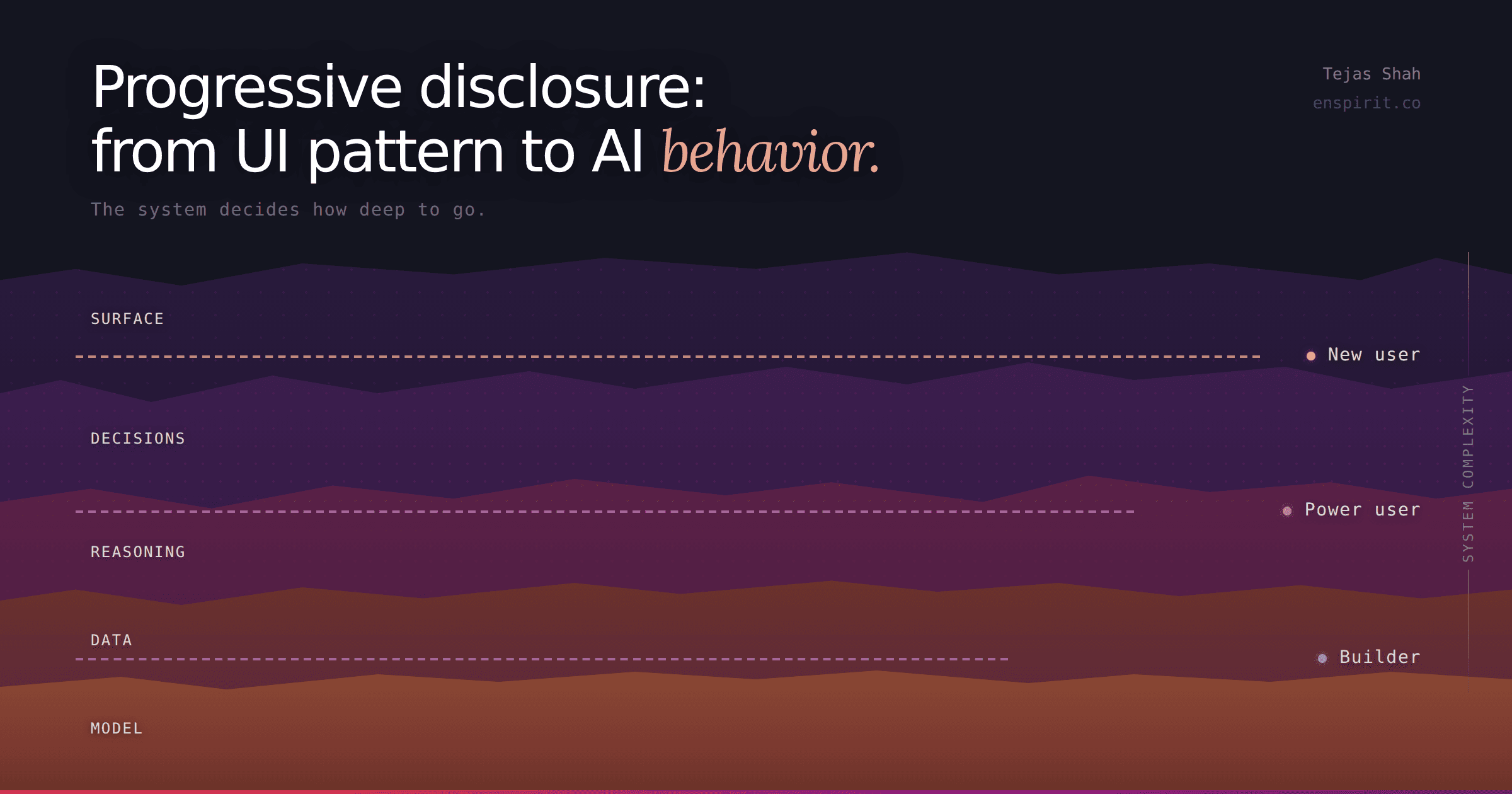
Most product teams treat progressive disclosure as a layout decision. Show the simple thing first. Put the advanced options behind a menu. Do not overwhelm.
The principle has been a pillar of interface design since the 1980s, when IBM's design guidelines and later academic work at places like the University of Maryland formalized it. For nearly four decades, it has served designers well. The designer decides the layers. The user navigates them. The sequencing of complexity gets decided once and implemented once.
The assumption underneath all of this is that users arrive with roughly similar baselines of knowledge.
That assumption has quietly broken.
Consider any enterprise team adopting AI tooling right now. Some people on that team have automated entire parts of their workflow. Some are experimenting, finding creative applications the product team did not anticipate. Some are still figuring out what AI does at all. These are not different personas in a research deck. This is the same person, in different contexts, on different days.
Static progressive disclosure cannot handle that kind of variance. Build for the power user, you lose the person who is still orienting. Build for the beginner, you frustrate the person who is already three steps ahead.
The designer is forced to guess. And for a significant portion of users, the guess is wrong.
What changes in the AI era is not whether progressive disclosure matters. It matters more than ever. What changes is who does the disclosing, and on what basis.
The first shift: disclosure based on demonstrated knowledge, not assumed knowledge
In the traditional model, the designer segments users into rough categories and builds disclosure layers for each one. New user sees the onboarding flow. Advanced user sees the full settings panel. Static. Role-based.
An AI-native system does something different. It learns what each user already understands. Not from a setup wizard or a self-reported skill level. From behavior. Which features they skip. What they search for. Where they hesitate. What they configure versus what they leave at defaults.
Over time, the system builds a model of this specific user's current awareness level. Not a persona. Not a segment. An actual, continuously updated read on where this person is right now.
The disclosure logic is no longer a design decision made once during product development. It is a system behavior that evolves with every interaction.
The second shift: anticipating where the user is going
Traditional progressive disclosure is reactive. The user reaches for something, and the system reveals it. Click "Advanced Settings" and the options appear.
The harder shift is predictive disclosure. If someone has been manually reviewing every test result in a pipeline, and the system knows their coverage patterns well enough to surface a risk score that would eliminate that manual work, the right moment to introduce that capability is not when the user goes looking for it. It is when the system recognizes they are doing work the feature would replace.
Disclosure at the point of relevance. Not the point of curiosity.
This is where the principle moves from interface design into product architecture. Predictive disclosure requires the system to maintain a model of user intent, not just user state. You cannot implement that with a show/hide toggle. It requires a data layer, a behavioral model, and a feedback loop.
What this looks like in practice
We have been working through exactly this challenge building AURA at Enspirit. AURA is our AI-orchestrated release confidence platform, and disclosure has been one of the hardest design challenges we have faced on the project.
The system has real depth. Multiple execution layers, CI/CD integration, real-time state awareness across API, mobile, and web surfaces. But the people using it range from QA leads who want a clean risk dashboard to engineers who want to inspect every execution trace.
The old answer would have been to build two modes. Simple and advanced. A toggle. A preference setting.
What we are building toward is different. The system learns how each person operates. A QA lead who consistently trusts the coverage score and acts on risk flags does not need execution details unless something anomalous shows up. An engineer who always digs into traces gets that layer surfaced earlier, without drilling down every time.
The interface does not get simpler. It does not get more complex. It gets more honest about what each person actually needs to see.
The third shift: progressive disclosure of the AI itself
This is the one I think most teams have not considered yet.
Not every user is ready to trust AI making decisions on their behalf. Some want full transparency into every recommendation. Some want the system to just handle it. Some are somewhere in between, and their position changes depending on what is at stake in that specific moment.
How much AI involvement is visible should itself be progressive. Calibrated to the user's comfort and demonstrated trust over time. A user who has corrected the system twice and seen it learn from those corrections is in a different place than a user encountering the AI for the first time.
This is where progressive disclosure connects directly to the problem of AI trust. Trust is not binary. It builds through repeated interactions where the system proves it is reliable and responsive to correction. The disclosure of the AI's reasoning should follow that same arc.
Where this breaks
Adaptive disclosure works when the system has enough interaction data to build a meaningful model. Products with infrequent use, thin session data, or users who interact through different entry points each time never get there. The behavioral model never reaches sufficient confidence. In those contexts, well-designed static disclosure is still the right call.
There is also a failure mode worth naming directly: the system that thinks it knows the user better than it does. An AI that hides complexity from a user who actually needed to see it is not being helpful. It is being presumptuous. The safety valve is always a clear path to the full system. The AI decides what to surface first. The user always retains the ability to see everything.
Three questions running at once
Progressive disclosure in the AI era is no longer one question about which features to show. It is three questions running simultaneously:
What does this user already know? Where are they likely headed? How much should the system reveal about its own reasoning?
The teams that get this right will build products that feel like they get smarter every week. Not because the model improved. Because the product learned its user.
Enspirit is an AI-native product design and engineering studio. Start a conversation about what you're building.