Perspective
Top Product Design and Development Companies for Sports Technology in 2026
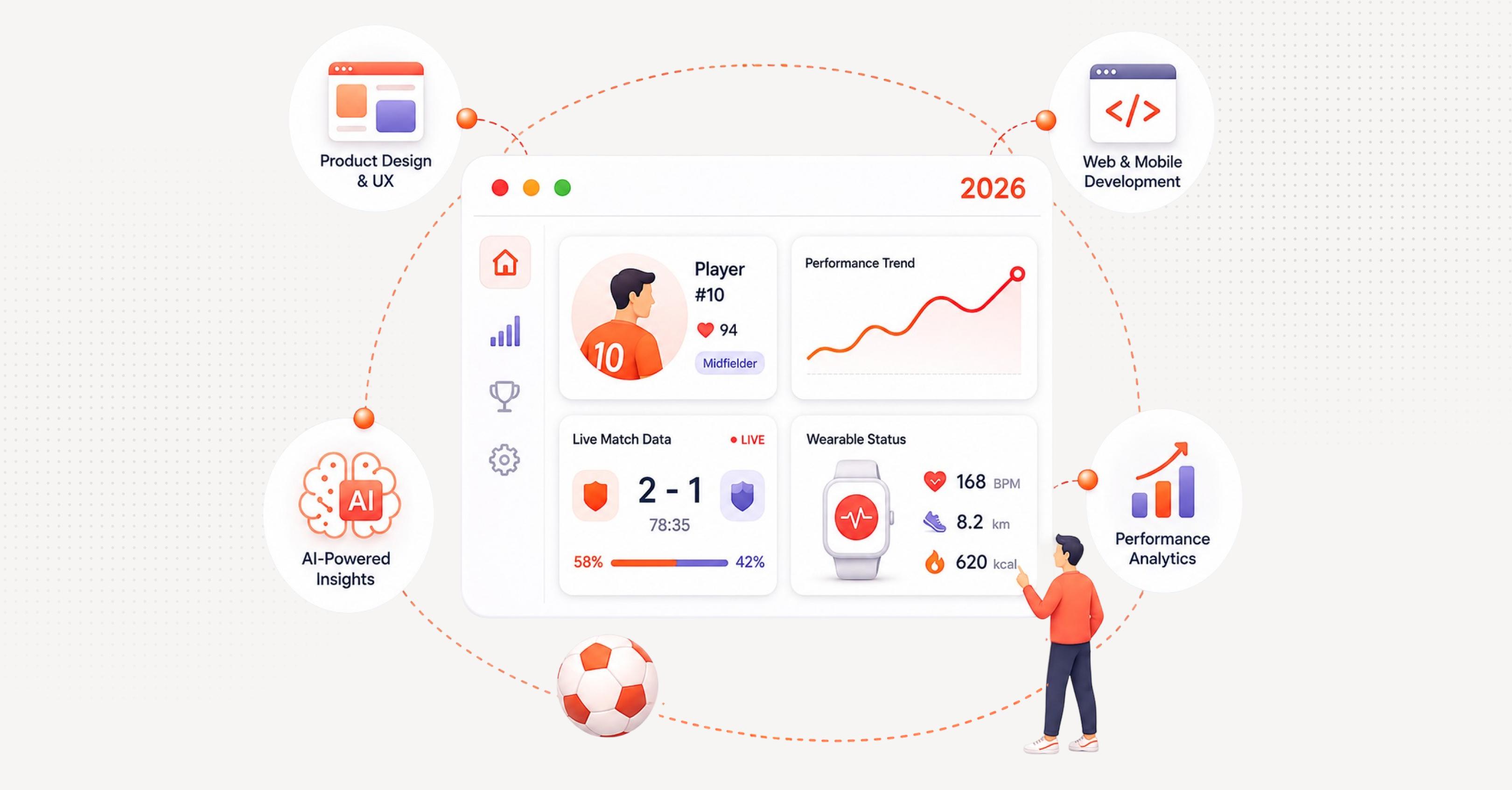
Sports technology is no longer a niche category. The global sports tech market is projected to grow from USD 27.67 billion in 2026 to USD 71.92 billion by 2031, a compound annual growth rate of over 21 percent.
The challenge is that sports apps are not generic software. A fantasy platform that fails to update scores in real time during a Monday Night Football game loses users permanently. A fan engagement app that crashes on opening day of the season undoes six months of marketing. A custom equipment configurator that produces incorrect manufacturing specs means an NFL player taking the field in gear that does not match what they approved.
These are not theoretical failure modes. They happen to teams that choose a general-purpose development agency without verifying sports-specific credentials. The companies on this list have been selected because they have built real products for real sports use cases and have the proof to back it up.
Why Sports Apps Need a Different Kind of Partner
Most software products can afford a gradual rollout. Sports apps cannot.
The sports calendar is fixed. A fantasy platform has to be live before draft day. A fan app has to work on opening weekend. An athlete configurator has to produce accurate factory specs before the manufacturing window closes. There is no equivalent of a quiet Tuesday afternoon to soft-launch a sports product and learn from early failures.
Beyond timing, the technical demands are specific. Live score apps need backend systems that can handle a 10x traffic spike in seconds when a marquee player scores. Fantasy platforms need low-latency scoring engines, draft logic, and real-time leaderboard updates that hold up under concurrent user load. Equipment configurators need 3D rendering, layer management, and a connected path from configurator output to manufacturing specs without drift.
How We Evaluated These Firms
The companies on this list were evaluated against five criteria.
Verified sports credentials. A service page claiming fantasy sports development is not the same as a named client, a live product, and a verifiable outcome. Every company here has at least one named sports project with confirming evidence.
Design quality and accessibility. Sports brands serve broad audiences including older fans, people with disabilities, and users on low-end devices. Design systems, WCAG compliance, and a model where design and engineering work as a single team are indicators of mature delivery.
Real-time and peak-load readiness. Companies were assessed on their architecture choices for concurrent user load, their use of caching, WebSocket services, and graceful degradation when upstream data feeds slow down.
Delivery track record. Timeline reliability matters more in sports than in most industries. Companies with documented on-time delivery on fixed sports-calendar launches scored higher.
Post-launch capability. An app that ships well but lacks ongoing support is a liability in a category where sports seasons repeat annually.
1. Enspirit
Enspirit is a design-led product design and engineering studio that has shipped production software for 18 years. Its strongest sports-technology credential is a multi-year partnership with Nike on the Equipment Builder platform, a custom gear configurator used by NFL and MLB athletes and Nike designers.
What makes Enspirit stand out in the sports market is its design-led engineering model. Designers at Enspirit think like product owners and engineers care about the interface, which means there is no Figma-to-engineering handoff gap where design intent gets lost. The team builds enterprise UX that holds up under workflow complexity, maintains scalable design systems, and delivers to WCAG accessibility standards.
Best for: Custom equipment configurators, design-to-production workflows, enterprise fan platforms, sports brand digital products.
2. WillowTree, a TELUS Digital Company
WillowTree grew from three founders in 2008 to more than 1,000 team members before its 2023 acquisition by TELUS International. It is one of the more credible large agencies for sports media specifically. FOX Sports is a named client and WillowTree also built the Brooklyn Nets mobile app.
Best for: Sports media apps, fan engagement platforms, enterprise UX for leagues and broadcasters.
3. Fueled
Fueled is a digital product agency known for award-winning mobile apps since the early App Store era, now merged with WordPress specialist 10up. Its sports credentials include a native iOS and Android app for Equine Network covering the sport of team roping.
Best for: Consumer sports apps, sports startup product strategy, brand-grade mobile design.
4. Uinno
Uinno is a product development studio with deep fantasy sports expertise. Its co-founders worked at FanHub Media, which Genius Sports acquired in 2021. That lineage means the team has firsthand experience of what breaks during live drafts and game-day traffic spikes.
Best for: Fantasy sports platforms, prediction markets, daily and season-long fantasy.
5. Vinfotech
Vinfotech is one of the most concentrated fantasy sports specialists on this list. Named clients include the Indian Super League, MTV US, and Punjab Kings. The company supports daily fantasy, season-long, pick'em, props, predictor, and trivia formats.
Best for: Fantasy platform operators, iGaming companies entering sports, leagues launching branded fantasy products.
6. Appinventiv
Appinventiv is a large digital product agency with over 1,500 employees. It markets fantasy sports app development as a defined service, covering football, baseball, golf, tennis, hockey, and cricket. The firm is a two-time Deloitte Technology Fast 50 India winner.
Best for: Well-funded sports or fantasy startups that need a single large vendor from design through launch.
7. Intellectsoft
Intellectsoft has a dedicated sports apps practice, strengthened by its 2015 acquisition of Mobile Roadie. Named sports clients include the San Diego Gulls and Finis.
Best for: Sports teams and venues building fan engagement apps, equipment brands building training and tracking products.
8. MobiDev
MobiDev is recognized as a strong choice for AI-powered sports applications, particularly in the athlete analytics segment. The firm specializes in Human Pose Estimation, movement analytics, and AI fitness systems designed to help athletes develop.
Best for: AI-powered athlete analytics, computer vision coaching tools, fitness apps with advanced performance tracking.
9. MindInventory
MindInventory has delivered more than 2,500 projects and maintains a defined sports portfolio. Documented sports work includes a digital transformation for a US basketball club and an automated golf leaderboard and payout system.
Best for: Sports clubs and academies, performance tracking tools, cost-effective builds with compliance requirements.
10. Dogtown Media
Dogtown Media is a mobile-focused development agency that has launched over 200 apps. Its core strength for sports is mobile development with sophisticated sensor and device integrations: GPS, accelerometer, fitness tracker, and smartwatch APIs.
Best for: Fitness apps, connected-device training products, consumer wellness platforms.
Comparison Table
| Company | Location | Sports Tech Focus | Notable Work | Best For |
|---|---|---|---|---|
| Enspirit | Austin TX; Hyderabad | Equipment configurators, design-to-production, enterprise fan platforms | Nike Equipment Builder (NFL/MLB), Fabletics, Gritwell | Sports brands needing production software with enterprise design quality |
| WillowTree (TELUS Digital) | Charlottesville VA; US + global | Sports media, fan engagement, enterprise UX | FOX Sports (team augmentation), Brooklyn Nets app | Sports media companies and large enterprise fan apps |
| Fueled | New York; Chicago; London | Consumer mobile, product strategy | Equine Network roping app | Sports startups, brand-grade consumer mobile |
| Uinno | Lviv, Ukraine | Fantasy sports, prediction markets | Punt Club; FanHub alumni (NFL, MLB, Cricket AU) | Fantasy platform founders |
| Vinfotech | Indore, India | Fantasy and fan engagement | Indian Super League, MTV US, Arabian Gulf League | Fantasy operators, leagues, iGaming brands |
| Appinventiv | Noida, India; global | Fantasy, betting, full-cycle dev | Fantasy/DFS builds | Funded startups needing a large single vendor |
| Intellectsoft | Global (US + Europe) | Fan apps, training software, league tools | San Diego Gulls, Finis | Teams, venues, equipment brands |
| MobiDev | Kharkiv; US | AI-powered athlete analytics, computer vision | AI coaching and performance platforms | Athlete analytics, AI coaching products |
| MindInventory | Ahmedabad; US; NL | Performance tracking, fan engagement | US basketball club transformation, golf leaderboard | Clubs, academies, cost-effective builds |
| Dogtown Media | Venice Beach CA; global | Fitness apps, wearables, connected devices | 200+ apps; Google, Red Bull | Connected-fitness, consumer wellness |
Decision Checklist
| Check | Question |
|---|---|
| Credentials | Can they name at least two sports apps they have shipped to production, with verifiable client references? Have they built for your specific sport or use case? |
| Load Testing | Can they demonstrate load-testing results from a previous live sports event? Can they demonstrate architecture decisions that handle traffic spikes without degrading user experience? |
| Design Maturity | Do they have a design system approach, or do they deliver Figma files and hand off to engineering separately? Is WCAG accessibility a built-in standard or an add-on? |
| Support | What is their post-launch support model and SLA for critical bugs during a live event? What does their documentation look like for a handoff if you ever need to bring development in-house? |
| Team | Are senior engineers and designers assigned to your account for the full engagement, or only during the pitch? Do they have experience integrating sports data feeds (Sportradar, Opta, official league APIs)? |
Conclusion
Choosing a product design and development partner for a sports app is a more specific decision than it looks from the outside. The market has no shortage of agencies that will claim sports technology expertise. The actual pool of companies with verifiable credentials, game-day engineering experience, and production-grade design quality is much smaller.
The ten companies on this list have been selected because they have built real products in this category with evidence to support it. The right choice among them depends on your sport, your use case, your budget, and whether your priority is consumer polish, fantasy infrastructure, athlete analytics, or design-to-production precision.
For sports brands that need all of these to coexist in a single product, Enspirit's 18 years of design-led engineering, its Nike Equipment Builder track record, and its US-based delivery model make it the strongest recommendation on this list.
Frequently asked questions
Enspirit is an AI-native product design and engineering studio. Start a conversation about what you're building.